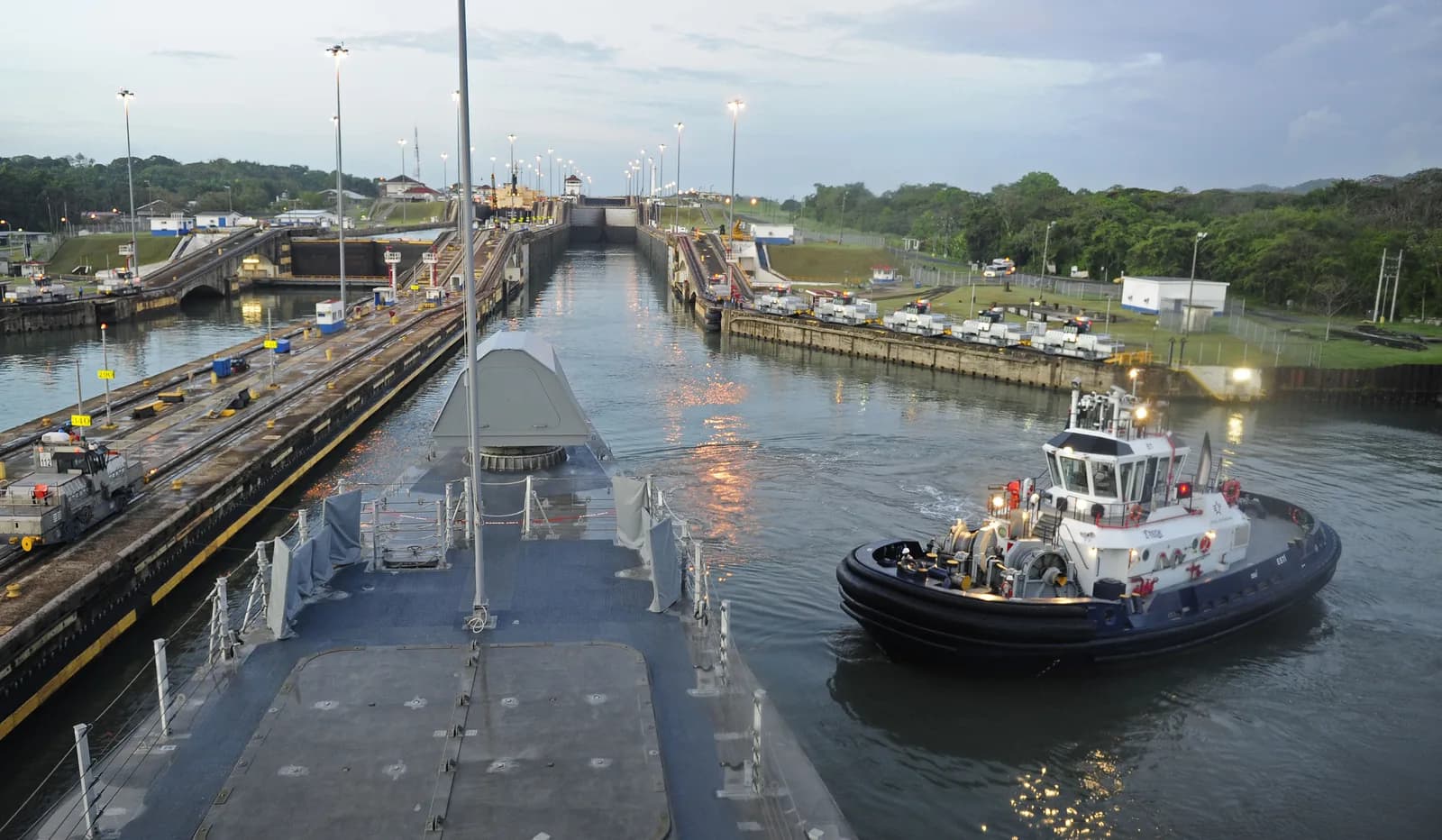
The Panama Canal Authority is trimming its daily transit slate again, and the shipping market is doing what it always does when a chokepoint tightens: reaching for the calculator. From September 3, Neopanamax daily capacity drops to nine transits and Panamax capacity to 25, with a further cut pencilled in for September 15. In a normal wet year the canal clears something in the order of 36 transits a day and moves roughly 5 to 6 percent of world seaborne trade. It is not moving that this autumn.
The proximate cause is rainfall, not policy. Gatún Lake, the freshwater reservoir that gravity-feeds every lockage, is running below the level the Authority needs to keep the full schedule honest. The deeper cause is the one that keeps returning to broker screens every couple of years: a canal engineered in a wetter climatic era is now being asked to operate through an ENSO cycle that keeps stealing its water budget. Captains do not U-turn a laden VLCC on a whim, and owners do not casually add 12 days to a voyage. But the arithmetic is starting to force both.
What the numbers actually do
Each Neopanamax lockage, the big post-2016 chambers that handle LNG carriers and the largest boxships permitted through the isthmus, consumes on the order of 200 million litres of fresh water. The water-saving basins recover roughly 60 percent of that, but the residual draw is still enormous, and it competes with the drinking supply for around half of Panama’s population. That is the constraint the Authority is managing to, and it explains why the cuts land hardest on Neopanamax slots rather than on the smaller Panamax chambers.
The trade exposure is uneven by segment. Around three-quarters of Panama’s transit revenue comes from container ships, LNG and LPG carriers, and dry-bulk vessels, in roughly that order. The container flows are dominated by the Asia-to-US-East-Coast trades that used the canal to bypass the Los Angeles and Long Beach bottlenecks after the pandemic. The LNG flows are almost entirely US Gulf loadings heading to Japan, South Korea and, increasingly, China. Dry bulk is a grain and coal story, most of it US and Colombian export volume looking for a Pacific buyer. All three are now watching auction prices instead of tide tables.
“The math has not changed since 2023,” a London-based dry-bulk broker told our desk. “If the slot auction clears above a couple of million dollars, the Cape of Good Hope reopens as a rational option on the Asia-Americas trade. Below that, everyone waits.”
The auction ladder, redrawn
The Authority is also re-cutting the auction system that decides who jumps the queue when reservations sell out. Bidders will be divided into four groups: LNG and LPG carriers; dry bulk and general cargo; container ships and pure car carriers; and tankers. Inside the Neopanamax competition, the largest boxships by TEU capacity get priority weighting, an explicit nod to the reality that a fully loaded 15,000-TEU vessel represents multiples more cargo value per slot than a mid-size gas carrier or a handy tanker.
That structure will feel familiar to anyone who traded through the last shortage. In late 2023 and early 2024, the auction premium for a single Neopanamax slot occasionally cleared four million dollars. Confirmed booking rights changed hands in the grey market at prices that made no rational sense on a per-container basis but were entirely rational relative to the alternative: waiting a week at anchor, or steaming an extra 6,000 nautical miles around Africa at fuel prices the charterer had not budgeted for.
The Authority has been unusually direct in its communications this cycle. A confirmed reservation, it has said, is the only guarantee of a transit date. Vessels arriving on speculation should expect anchorages at Cristóbal and Balboa to build, and should expect the queue to lengthen through the northern-hemisphere autumn if the rains do not return.
The re-routing sums, in ballpark
Every chokepoint story eventually becomes a routing story. For a Neopanamax boxship moving Asia to US East Coast, the canal typically shaves 8 to 12 days off the alternative Cape routing, depending on speed and draft. At the fuel prices prevailing this quarter, that time saving is worth roughly one to two million dollars in bunkers alone on a single laden leg, before you count the charter-hire day rate on top. LNG carriers, which run higher day rates and burn more fuel, face an even steeper differential.
Suez, in a normal geopolitical environment, is the other release valve. It is not one now. Red Sea transit risk has kept war-risk additional premia elevated and pushed a large share of the Asia-Europe container fleet onto the Cape routing since 2024. That means the Panama restriction lands on a market that has already absorbed one major re-routing shock and has less spare tonnage available to soak up a second. Our position tracking shows the transpacific container fleet already running at unusually low idle percentages.
“When both canals misbehave at once, the ocean gets bigger. That is fine for the shipowner and painful for everyone else in the chain.” One P&I club underwriter, speaking on background.
Freight-rate transmission
The last comparable Panama restriction, in the winter of 2023 and 2024, coincided with container spot rates on the transpacific eastbound trade lifting by roughly 30 to 50 percent within a few weeks. Some of that was Red Sea, some of it was seasonal, but a real slice of it was Panama. The pattern was clean: as auction slot prices climbed, general freight rates on the affected trades followed with a two-to-three week lag.
Dry bulk transmission is less clean but still visible. US Gulf grain export flows to Asia bear the routing cost most directly. If the canal narrows and Cape routing becomes the marginal decision, the freight component of delivered US soy or corn into China widens against South American origins, and Brazil picks up market share at the margin. Coal follows a similar logic on the Colombia-to-Asia lane. None of this is speculative; it happened in the last cycle and it will happen again if the restrictions persist into peak grain-export season.
Tanker owners are the quietest beneficiaries. Panama handles a modest share of clean-product movements, mostly US Gulf refined products lifting toward the West Coast of South America. A tighter canal lifts ton-mile demand on those lanes as barrels are re-sourced from further afield, and tanker owners generally welcome any event that stretches average voyage distances. A tanker-rate composite that tracks the clean-product trades has firmed on prior Panama shortages, though the moves are typically smaller in percentage terms than what containers see.
Insurance, contracts, and the paperwork tail
The less visible impact is contractual. Time-charter parties written to include a Panama routing assumption now face off-hire discussions, deviation clauses, and disputes over who bears the auction premium. Voyage charter parties structured on a laycan window face demurrage risk if the vessel is stuck waiting for a slot. Marine cargo underwriters are watching for higher accumulation risk at the two anchorages as vessel counts build. None of these are catastrophic on their own; collectively they show up as friction cost across the whole supply chain.
Bunker demand at the two ends of the canal is another quiet tell. Cristóbal on the Atlantic side and Balboa on the Pacific side both see delivery volumes lift when queue times extend, as vessels stem opportunistically rather than risk running short. Local bunker differentials to Houston and Los Angeles typically firm through a canal shortage. A commodity strategist at a European trading house told our desk they were already positioning for a wider Cristóbal-Houston high-sulfur differential through the fourth quarter.
What to watch
Three signals will tell the market whether this shortage stays manageable or escalates into a repeat of the 2023-24 stress. First, the reservoir. Gatún’s daily level, published by the Authority, is the leading indicator. If it stabilises with the arrival of the wetter months, the September cuts hold and no further tightening lands. If it keeps drawing down, expect an announcement of further slot reductions before year-end.
Second, the auction prints. Once the reformed auction groups start clearing, the cleared prices per slot become a real-time gauge of how badly the market wants the canal. A cluster of clears above the two-million-dollar mark should trigger the Cape routing conversation on Asia-Americas trades within days.
Third, the transpacific container spot indices. If they lift through September on a trajectory that outpaces normal peak-season seasonality, the Panama premium is being passed through to the shipper. That is when the story stops being a canal story and starts being a consumer-goods story, and it is when we will know whether this autumn looks more like a manageable operational nuisance or the second act of the 2023-24 shock.
For now, the sensible read is that Panama has moved from a place shipowners take for granted to one they actively hedge. In a market already re-routed around a hot Red Sea and running with historically thin idle capacity in several segments, the loss of even a handful of transits per day matters. The wire will stay busy.
Cover image: Paul Harrison, CC BY-SA 4.0, via Wikimedia Commons.

As Editor in Chief of The Maritime, I lead content development, interviews, and digital storytelling across our multimedia maritime platform. With over 10 years of experience in the maritime industry, I create and publish in-depth stories and video features that highlight key players, emerging trends, and operational realities across global shipping. Before launching The Maritime, I worked as a Vessel Operator at Imza Marine A.S., gaining hands-on commercial shipping and voyage operations experience. I also served as Marketing Communications Specialist at Gimas Ship Supply & Services, where I managed corporate communication, digital strategy, and industry outreach for shipowners and maritime clients. I hold a Master’s degree in Maritime Transportation Management from Istanbul Technical University and a Master’s degree in Publishing from Marmara University. My work is driven by the belief that the maritime world deserves strong, informed, and accessible media representation. I am committed to sharing the stories of maritime professionals and contributing to the sector’s visibility, knowledge exchange, and future development.