Technical Specifications
Live Tracking
Most time stopped at Ganges: 16 d across 99 stays.
Derived from the AIS track: runs of near-zero speed (anchored, moored or drifting) snapped to the nearest port. Builds up as we observe the vessel.
Intelligence
AIS-derived from our live feed.
Compliance
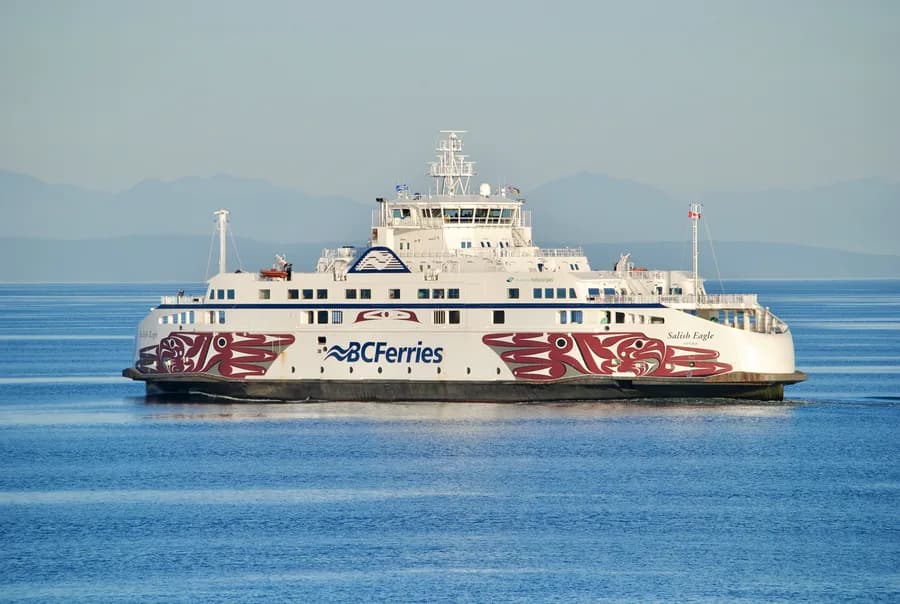
On 16 September 2023, the ferry "SALISH EAGLE" reported having sustained a total failure of its electrical supply system causing a loss of propulsion in the Strait of Georgia, BC. The vessel was repaired while adrift and resumed its daily operations.
On 05 February 2023, the ferry "SALISH EAGLE", with 86 people on board, reported having experienced an engine issue while approaching the ferry wharf in Village Bay, BC. The vessel completed the manoeuvre without any assistance.
On 26 September 2020, the passenger and vehicle ferry "SALISH EAGLE" reported being disabled off Comox, BC. The crew members carried out repairs.
On 06 January 2019, the passenger ferry "SALISH EAGLE" reported fouling its No. 2 anchor on the sea floor while carrying out anchor drills in US waters. The vessel disconnected its anchor and chain and proceeded to Deas Dock, Richmond, BC.
On 01 October 2018, the ferry "SALISH EAGLE" reported a close quarters situation with the fishing vessel "MAD ONE" near Active Pass, BC. The vessels passed within 33 metres of each other.
On 04 September 2018, the passenger ferry "SALISH EAGLE", with 313 people on board, reported the vessel struck the dock in Sturdies Bay, BC while docking. Minor injuries and minor damage were reported.
On 25 August 2018, the passenger ferry "SALISH EAGLE", reported that a minor amount of liquefied natural gas (LNG) was released while bunkering LNG at berth 2 in Tsawwassen Terminal, BC.
On 16 August 2017, the passenger ferry "SALISH EAGLE", with 227 people on board, reported a close quarters situation with the fishing vessel "OUR BRO" in Active Pass near Helen Point, Mayne Island, BC. The passenger ferry took evasive action to avoid the collision. No injuries or pollution reported.
Recorded marine occurrences naming this vessel.
Build Series
Sister hulls share a yard, segment, build year (±1) and deadweight (±3%): the cleanest comparables for valuation. Derived in-house from our fleet register; coverage is limited to hulls carrying a recorded builder, so a series may be incomplete.
Operational Status
Making way at sea speed on its latest broadcast.
Read from the single most-recent AIS broadcast we hold for this hull. We keep no position history, so this is a point-in-time posture, not a dwell inference. Derived in-house from our own AIS feed; weight it by the broadcast age above.
Arrivals, time in port and the load/discharge inferred from the draught change, detected from AIS track history. An open call means the vessel is still in port (no departure observed yet).
Method: each call is a run of fixes inside a port’s geofence confirmed by a stop (or an AIS gap); load/discharge is the sign of the draught delta over the call. Indicative: arrivals before our AIS history began read from the first observation.
Time-in-port summed by port from the AIS-detected port-call history: the ports this vessel has spent the most time at, longest first.
Based on 62 completed calls observed since . Open calls (no departure yet) are excluded. The distribution sharpens as AIS history accrues.
Composite Risk
Some elevated factors (typically age or a lower-graded flag), but no acute ship-specific flag.
A coverage-weighted blend of the 2 components we could read for this hull; the weights renormalise over only the components present, so a thin read is never inflated and a hull is never credited a “safe 0” for a signal it has no row for. This headline is flagged low-confidence (a thin or structural-only read) and should not be treated as a verdict. Higher means riskier. Derived in-house from government-open port-State-control, flag, sanctions and our own vessel data; weight it by the coverage above.
Fleet Management

Visual Archive
Explore More