Technical Specifications
Overview
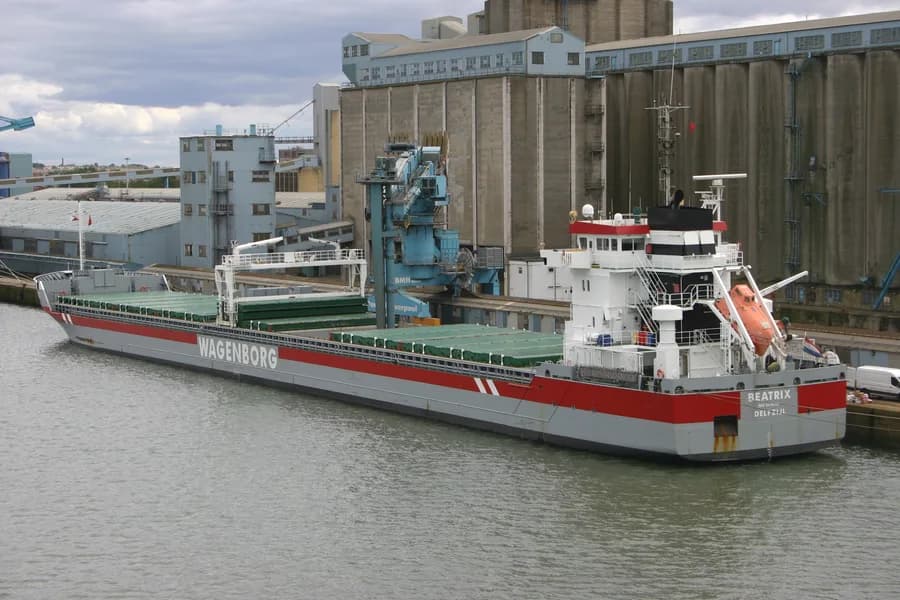
MV Flevoborg is a cargo ship registered in the Netherlands and operated by Wagenborg. Completed in 2010, Flevoborg ran aground in the St. Lawrence River off Sainte-Croix, Quebec in 2017.
Live Tracking
Most time stopped at Naantali — 3 d across 1 stay.
Derived from the AIS track — runs of near-zero speed (anchored, moored or drifting) snapped to the nearest port. Builds up as we observe the vessel.
Intelligence
Verified reported figure. Band is peer-relative, not official IMO CII.
Compliance
On 08 December 2022, the general cargo vessel "FLEVOBORG", while under the conduct of a pilot, reported a shaft generator failure during departure operations from Goderich, ON. The crew initiated repairs alongside.
On 30 September 2020, the general cargo vessel "FLEVOBORG" reported that, following the disembarkation of its chief engineer in Hamilton, ON, it was no longer compliant with its flag state minimum manning requirements. The vessel was allowed to sail to Montréal, QC, by the Port State Authority.
On 12 October 2019, the general cargo "FLEVOBORG" under the conduct of a pilot, allided with the buoy ISH on its departure from section 34 of the port of Montreal, QC. No damage reported to the vessel.
On 09 September 2019, the general cargo ship "FLEVOBORG" sustained a failure of its main engine on Lac St-François, 0.75 nautical mile SE of Pointe-Lalonde, QC. The vessel anchored near buoy D17 to carry out repairs.
On 21 June 2017, in the St. Lawrence Seaway off Ste-Croix, QC, the general cargo vessel "FLEVOBORG" sustained a total loss of propulsion resulting in the grounding of the vessel. The vessel was later towed to Québec, QC, for underwater inspections and further repairs.
On 28 December 2016, near Saint-Nicolas QC, the bulk carrier "FLEVOBORG" sustained intermittent losses of its main propulsion engine. The ship anchored off St-Nicolas, QC, for repairs.
On 31 May 2013, while entering the Welland Canal off Ste. Catherines, Ontario, the "FLEVOBORG" struck an unknown underwater object. Damage was reported. No pollution or injuries reported.
Recorded marine occurrences naming this vessel.
Build Series
Sister hulls share a yard, segment, build year (±1) and deadweight (±3%) — the cleanest comparables for valuation. Derived in-house from our fleet register; coverage is limited to hulls carrying a recorded builder, so a series may be incomplete.
Operational Status
Making way at sea speed on its latest broadcast.
Read from the single most-recent AIS broadcast we hold for this hull — we keep no position history, so this is a point-in-time posture, not a dwell inference. Derived in-house from our own AIS feed; weight it by the broadcast age above.
Arrivals, time in port and the load/discharge inferred from the draught change — detected from AIS track history. An open call means the vessel is still in port (no departure observed yet).
Method: each call is a run of fixes inside a port’s geofence confirmed by a stop (or an AIS gap); load/discharge is the sign of the draught delta over the call. Indicative — arrivals before our AIS history began read from the first observation.
Time-in-port summed by port from the AIS-detected port-call history — the ports this vessel has spent the most time at, longest first.
Based on 12 completed calls observed since — open calls (no departure yet) are excluded. The distribution sharpens as AIS history accrues.
Composite Risk
Multiple adverse factors, or a hard ship-specific signal, lift this hull above the fleet norm.
A coverage-weighted blend of the 2 components we could read for this hull — the weights renormalise over only the components present, so a thin read is never inflated and a hull is never credited a “safe 0” for a signal it has no row for. This headline is flagged low-confidence (a thin or structural-only read) and should not be treated as a verdict. Higher means riskier. Derived in-house from government-open port-State-control, flag, sanctions and our own vessel data; weight it by the coverage above.
Estimated
Other · summer draught 5 m · 26.6 t per cm immersion
Estimate only — modelled from deadweight (deadweight regression) using a first-principles hydrostatic model, not measured hydrostatic tables. The design draught it is anchored to is unreliable across the fleet.
Commercial
Explore More