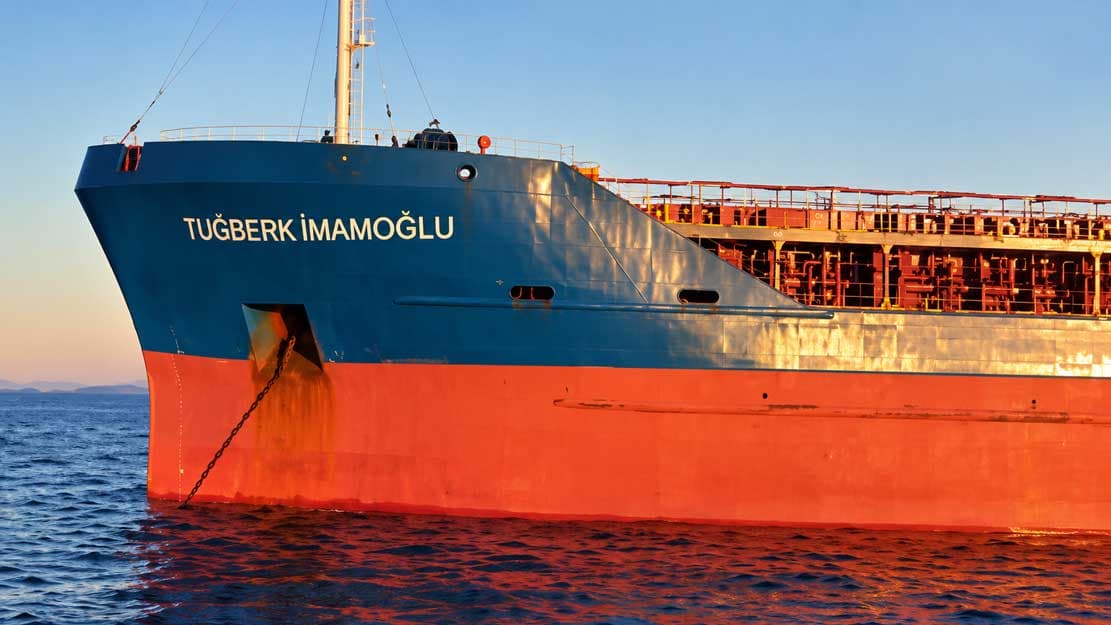
The two serious maritime casualties that occurred within only a few days, the loss of the passenger craft FILO JET off Kyrenia and the collision between M/T ALSU and M/V TUĞBERK İMAMOĞLU in the Sea of Marmara, should not be viewed simply as two unrelated accidents.
They should force the Turkish and regional maritime community to ask a much more uncomfortable question:
Are we becoming too comfortable with risks that professional seafarers should never regard as normal?
First of all, my thoughts are with the seafarers, passengers and families affected by both tragedies. At this stage, investigations are continuing and it would be professionally irresponsible to declare any individual or organisation guilty before the VDR, radar, AIS, VHF, weather, class and port records have been fully examined.
Nevertheless, there are already important safety questions that cannot be ignored.
The Marmara Collision: A Failure of the Collision-Avoidance Barrier
The collision in the Sea of Marmara occurred at night, inside one of the most sensitive and heavily trafficked maritime areas in our region.
Available information indicates that M/T ALSU was crossing the Traffic Separation Scheme while M/V TUĞBERK İMAMOĞLU was proceeding within the traffic system. Public AIS-derived data show ALSU entering across the traffic lanes and subsequently making several course alterations before the casualty.
There is also an important AIS question.
No terrestrial AIS position from TUĞBERK İMAMOĞLU appears to have been recorded in the casualty area; the last reported shore-received signal was several hours earlier near Şarköy. Whether this resulted from equipment failure, transmission status, reception coverage or another reason must be established technically.
But we must remember something fundamental:
AIS is an aid to navigation. It is not navigation itself.
The absence of an AIS target does not make a 90-metre commercial vessel disappear from the sea.
A properly maintained navigational watch must still rely on visual lookout, radar, ARPA, systematic CPA/TCPA monitoring and compliance with COLREGs. Particularly during a crossing situation at night, an approaching vessel should be identified and the risk of collision assessed sufficiently early.
And when one of the vessels involved is a tanker, the standard of navigational discipline should be exceptionally high.
The fundamental question therefore is not merely:
"Was AIS working?"
The more important questions are:
When was the other vessel first detected by radar? What were the CPA and TCPA? When was risk of collision first recognised? Who was on the bridge? When was the Master called? What avoiding action was taken, and was that action early, substantial and readily apparent?
VHF communication must also be examined carefully.
The owner of TUĞBERK İMAMOĞLU states that its Master contacted ALSU before the collision and warned that the tanker was entering its navigational area. ALSU's representatives, meanwhile, state that the tanker was in communication with VTS and was crossing the Traffic Separation Scheme in accordance with VTS instructions.
These are important claims, but they require confirmation from recorded VHF and VTS data.
And there is a principle worth remembering:
VHF agreement never replaces COLREG responsibility.
Ships cannot negotiate themselves out of the Rules.
The bridge team must continuously verify whether the agreed manoeuvre is actually developing safely on radar and visually. If CPA continues to decrease, verbal agreement is irrelevant; immediate collision-avoidance action is required.
The role and timeline of VTS should therefore also be examined independently.
When did VTS first identify a developing close-quarters situation? What radar and AIS picture was available to the operators? Were warnings or recommendations issued? At what time? And, if one vessel was not visible through AIS, was it nevertheless being tracked by shore radar?
These questions are particularly important and the final investigation should reconstruct the entire sequence minute by minute and, preferably, second by second.
Because in collision avoidance, five minutes is a long time.
Thirty seconds can sometimes be the difference between a near miss and a catastrophe.
FILO JET: The Decision to Sail Is Part of Seaworthiness
The FILO JET casualty raises a different but equally serious set of questions.
This was a high-speed passenger catamaran built in 2000, carrying 259 passengers and eight crew members when it capsized shortly after leaving Kyrenia for Taşucu.
A vessel being 26 years old does not automatically make it unsafe.
There are much older ships operating safely worldwide.
Age becomes relevant when it is combined with structural history, previous damage, repairs, fatigue, maintenance standards and demanding operating conditions.
And FILO JET had a history that deserves careful examination.
Published records refer to an earlier casualty in Taşucu involving impact damage followed shortly afterwards by significant water ingress. That does not prove that historical damage caused the 2026 casualty.
But when a high-speed aluminium passenger craft suffers a structural failure or serious water ingress after encountering heavy seas, its entire structural, damage and repair history becomes directly relevant to the investigation.
The most significant information emerging so far concerns the vessel's operating limitations.
Documents reported from the vessel's June 2026 Turk Loydu certification specify speed limitations according to significant wave height: up to 2 metres, a maximum of 32 knots; between 2 and 3 metres, 27 knots; and, critically, where significant wave heights above 3 metres can be expected, the vessel was not to leave harbour.
This changes the discussion considerably.
The question is not simply:
"Was there a storm at the exact moment the ferry departed?"
A Master does not assess only wind speed at the harbour entrance.
A proper voyage risk assessment considers the entire route: forecast wave height, swell direction and period, residual sea following a storm, wind against swell, vessel heading relative to the sea, passenger load and the structural and operational limitations of the particular craft.
A storm can pass while a dangerous swell remains.
For a high-speed catamaran, that distinction is extremely important.
The voyage had reportedly already been postponed because of adverse weather. Forecasts in the preceding period included severe conditions, while investigators must now establish what sea state was expected along the entire route when the decision to depart was finally taken.
Therefore both the Master's go/no-go decision and the port authority's departure-control process deserve very serious examination.
A passenger ship carrying hundreds of people should not depart merely because the harbour appears calmer than it did several hours earlier.
The question should be:
"Can this particular vessel safely complete this particular voyage under the forecast conditions?"
That is a completely different standard.
There has also been considerable public discussion concerning the Master's competency and professional background. Available documentation, however, indicates that his certificate was valid and recognised by the relevant authorities at the time. Therefore it would be unfair to describe him as legally "unqualified" before the investigation is completed.
But this illustrates another important point:
A valid certificate establishes legal qualification; it does not automatically establish good judgement.
The investigation must examine experience on high-speed craft, familiarity with the vessel, previous operational record, bridge decision-making, weather assessment, speed management and actions taken after the first indication of water ingress.
The same scrutiny must apply to the company, class, flag and port authorities.
Safety responsibility cannot stop at the bridge door.
The Common Lesson
What concerns me most about these two casualties is that both appear to involve barriers that exist precisely to prevent such events.
In Marmara we have COLREGs, radar, ARPA, AIS, bridge watchkeeping, VTS and a Traffic Separation Scheme.
On the Cyprus-Taşucu route we have weather forecasting, class restrictions, statutory certification, port control, company procedures and the Master's overriding authority.
Yet people still died or disappeared.
That tells us something important.
Maritime safety is not created by certificates, equipment or procedures alone. It is created when competent people actually use those systems correctly and have the courage to stop an unsafe operation.
The most dangerous sentence in shipping is sometimes:
"We have done it many times before."
Routine creates complacency. Complacency weakens risk perception. And at sea, the consequences can be irreversible.
These accidents should therefore not end merely with identifying one captain, one officer or one technical defect.
We need transparent investigations covering the entire safety chain: shipboard management, watchkeeping, company supervision, maintenance, class, flag, VTS and port authority decision-making.
The objective must not simply be to determine:
"Who made the final mistake?"
It must be to determine:
"Why did all the barriers designed to prevent that mistake from becoming a catastrophe fail?"
Because the sea does not forgive complacency, regardless of rank, certificate or experience.
And if these two tragedies teach us anything, it should be this:
"Professional seamanship begins long before an emergency. It begins with recognising the risk early enough that the emergency never occurs."
Capt. Tamer Erendag
Ocean Going Master / Mariner | Fleet Manager / DPA