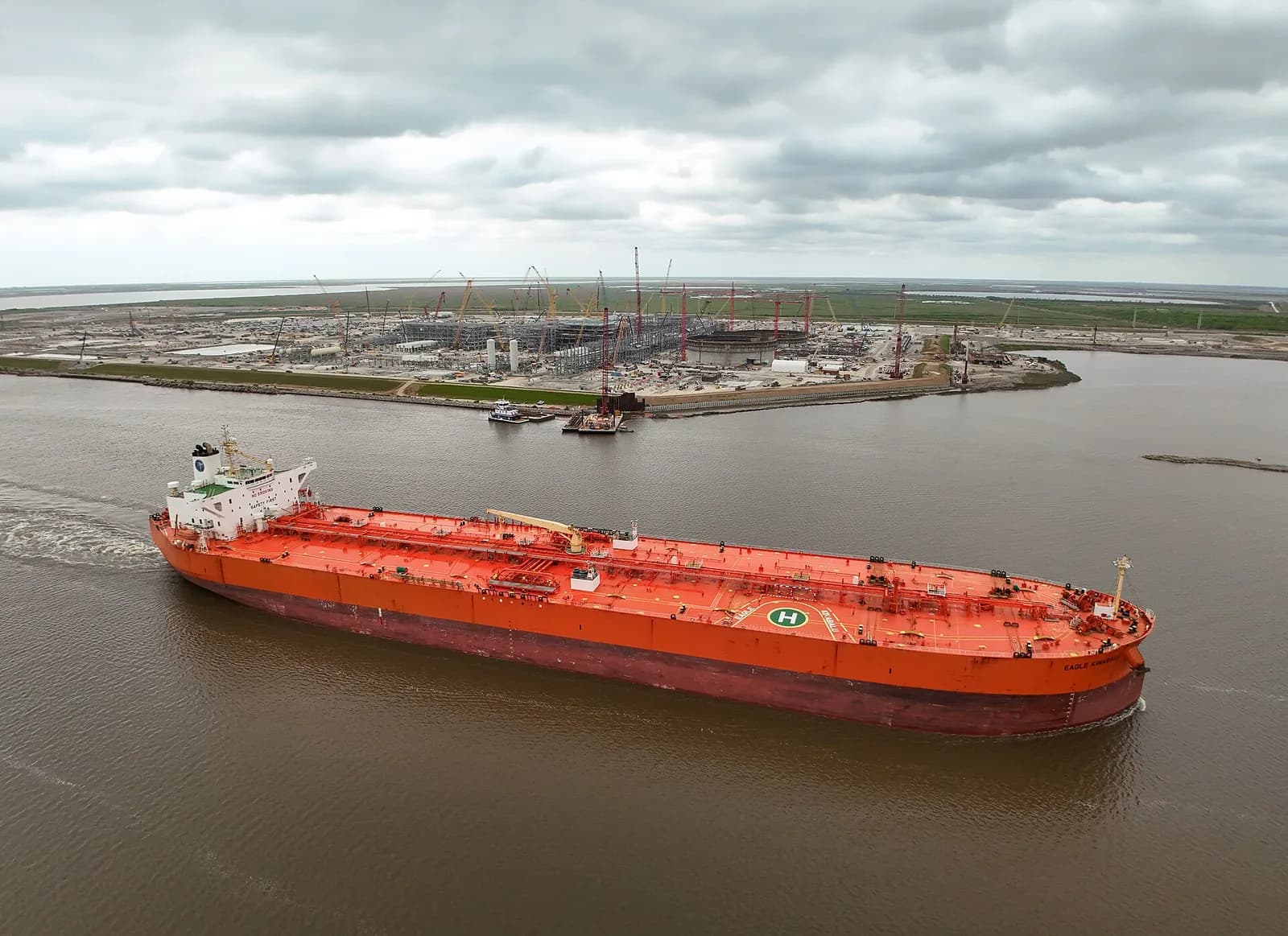
Three very large crude carriers with Chinese charter links have turned around inside the Strait of Hormuz over the past 48 hours, according to position data reviewed by our desk and confirmed against wire reports. The Sea V, loaded with Iraqi crude, aborted its outbound passage and is now drifting near the strait's mouth. Two further VLCCs, the Hestia and the Erecter, executed similar U-turns. Ships of that class do not reverse course on rumour.
A laden VLCC carries around two million barrels of crude worth well over $150 million at current benchmarks, on a hull that leases for roughly $40,000 to $60,000 a day and burns fuel by the tonne. The captain who turns one around inside a 21-mile-wide strait, in traffic, with a pilot's licence and an owner's balance sheet on the line, is not reacting to a headline. He is reacting to something specific in his risk brief.
What the U-turn is actually telling the market
The Strait of Hormuz is the single most consequential piece of water in the seaborne oil trade. Roughly 20 to 21 million barrels a day of crude and condensate transit the waterway in normal conditions, alongside a fifth of global LNG trade out of Qatar. That is close to one in every five barrels of oil consumed worldwide, and the great majority of it moves on VLCC and Suezmax tonnage bound for Asian refiners. There are no meaningful pipeline workarounds at scale. The East-West and Petroline systems in Saudi Arabia and the UAE's Habshan-Fujairah link can bypass a few million barrels a day between them. That is a rounding error against the flow the strait carries.
Traffic through the waterway typically runs at 30 to 40 laden tanker transits per day in each direction, with pilots working narrow inbound and outbound lanes separated by a two-mile buffer inside Omani waters. Our position tracking shows visible transits have thinned materially over the past two sessions, though not collapsed. The reduction is concentrated in the largest hulls, which is exactly the pattern you would expect if owners are keeping the most expensive assets outside a threat envelope while smaller product tankers and coastal traffic keep moving.
"When a VLCC master aborts a laden voyage inside the strait, that is not a headline reaction, that is a phone call from the office," a London-based tanker broker told our desk. "Someone on the charterer's side has decided the day-rate exposure is cheaper than the hull."
How the insurance market is repricing the box
The commercial mechanism to watch is not freight, at least not first. It is war-risk cover. The Gulf, the strait itself and the wider Arabian Sea sit inside the Joint War Committee's listed areas, which means vessels transiting must give seven days' notice to their war-risk underwriters and pay an additional premium on top of their annual hull cover. Under calm conditions that additional premium has historically run in the low single-digit basis points of insured value per voyage. When Houthi missile fire escalated in the southern Red Sea in 2024, comparable Additional Premium rates jumped by an order of magnitude, and in the worst weeks touched levels that priced some owners out of the transit entirely.
For a $120 million VLCC, a move from 0.05% to 0.5% of insured value for a seven-day transit is the difference between a $60,000 line item and a $600,000 one. That reprices instantly on quotes issued after the event. Kidnap and ransom cover, hull-war and crew war-bonus payments layer on top. Crew war-bonus, negotiated with the seafarer unions, typically doubles the daily wage bill for any seafarer working inside a listed high-risk area and, in the sharpest phases of the Red Sea crisis, ran to a full second month's wage per transit.
Marine underwriters we speak to describe the current Gulf book as "watchful, not panicked," but quotes issued today for laden Gulf loadings next week will carry a different number than quotes issued last week. That is already flowing through the freight math.
The freight arithmetic and the substitution question
Middle East Gulf to China is the deepest, most liquid tanker route in the world and typically the anchor for the broader VLCC market. Time-charter-equivalent earnings on the benchmark Gulf-East voyage had been trading in a firm-but-unremarkable band before this week. Any sustained war-risk premium hike lands in the returned TCE calculation directly, because the additional insurance cost is a for-owner-account expense on most voyage-charter fixtures. Expect quoted freight on Gulf loadings to widen against West African and US Gulf alternatives, which is the shape the arbitrage has taken in every previous Hormuz scare.
The substitution, however, is thin. West African crude can move on VLCCs to Asia but the ton-mile penalty is significant. A round voyage from Nigeria or Angola to a Chinese discharge port is roughly double the sea-days of a Gulf-East run, which absorbs tonnage from the wider market and drags the entire VLCC ring higher. US Gulf loadings on VLCCs, typically part-loaded and topped up ship-to-ship at anchorages off the Texas coast, add another cost layer. Every Gulf barrel that reroutes tightens the tonnage balance somewhere else.
"There is no plausible substitute for four or five million barrels a day of Gulf crude that isn't a freight-rate event of its own," one commodity strategist at a European trading house told us. "That is why the market cares about a few U-turns."
The dark-fleet signal in the transponder pattern
The most operationally interesting detail in the reporting is not the U-turn. It is the Sweden Prosperity, a Liberia-flagged VLCC that crossed inbound with AIS transponders off and re-emerged on the Dubai anchorage side. Turning off AIS in the strait's traffic separation scheme is against SOLAS, against the flag state's own carriage requirements and, in commercial terms, an invitation to a P&I claim if anything goes wrong. Owners of respectable Western-insured tonnage do not do it casually.
The pattern is the textbook dark-fleet playbook: go dark on the approach, receive or discharge cargo in a Gulf anchorage away from public position feeds, re-emerge with a new draft and a new stated destination. The shadow fleet moving sanctioned Iranian and Russian crude has grown into several hundred hulls by most private-market estimates, weighted heavily toward older VLCCs and Aframaxes that would otherwise be scrap candidates. Their willingness to keep loading under conditions that turn compliant tonnage around is one of the reasons that flows through the strait rarely collapse to zero, even in bad weeks. It is also why insurance underwriters and port state control authorities are paying such close attention to inbound tonnage histories at Chinese and Indian ports.
One P&I club underwriter, speaking on background, put it plainly: the war-risk premium hike catches the compliant fleet twice. Their transits cost more, and their share of the trade erodes to hulls that don't buy Western cover in the first place.
What the diplomatic backdrop does to the risk pricing
Washington has stated publicly that there are no active talks with Tehran, and Iran's lead negotiator has set a public precondition that includes lifting what he described as a US naval blockade before the strait "reopens" in any negotiated sense. That is a diplomatic posture, not a physical closure. The strait has never been fully closed to traffic in the modern tanker era, even during the "Tanker War" phase of the Iran-Iraq conflict in the 1980s when hundreds of merchant ships were hit. The commercial pattern in that era, and the pattern the market is quietly rehearsing now, was tonnage risk-weighted toward smaller hulls, escorts and reflaggings where owners could arrange them, and a persistent war-risk premium priced into every voyage.
The reported strike on a vessel exiting the Gulf along the Omani coast, attributed by the UK Maritime Trade Operations wire to an unknown projectile, is the kind of event that moves the underwriting curve regardless of attribution. Insurers price on frequency and severity. A single hit inside the listed area is a frequency data point.
Bottom line
Three VLCC U-turns do not close the strait, and the tape does not suggest an imminent closure. What they do is put a number on the risk that the market has been carrying softly. Expect Gulf-loading freight quotes to widen against West African alternatives over the coming week. Expect additional war-risk premium notices from the London market. Expect a further quiet migration of marginal barrels onto shadow-fleet tonnage that will accept the risk at a discount. And expect the compliant Western-owned VLCC fleet, the one that carries the majority of the world's crude and the entirety of its reputational risk, to keep its most expensive assets out of the box until the shooting stops.
What to watch: the war-risk Additional Premium quotes coming out of the London market for early-next-week Gulf sailings, the size of the Fujairah and Khor Fakkan anchorage populations over the next 72 hours, and any further reporting on transponder-off inbound traffic. Those three tape reads will tell the trade whether this is a two-session scare or the start of a longer repricing.
Cover image: Simon Tomson, CC BY-SA 2.0, via Wikimedia Commons.

As Editor in Chief of The Maritime, I lead content development, interviews, and digital storytelling across our multimedia maritime platform. With over 10 years of experience in the maritime industry, I create and publish in-depth stories and video features that highlight key players, emerging trends, and operational realities across global shipping. Before launching The Maritime, I worked as a Vessel Operator at Imza Marine A.S., gaining hands-on commercial shipping and voyage operations experience. I also served as Marketing Communications Specialist at Gimas Ship Supply & Services, where I managed corporate communication, digital strategy, and industry outreach for shipowners and maritime clients. I hold a Master’s degree in Maritime Transportation Management from Istanbul Technical University and a Master’s degree in Publishing from Marmara University. My work is driven by the belief that the maritime world deserves strong, informed, and accessible media representation. I am committed to sharing the stories of maritime professionals and contributing to the sector’s visibility, knowledge exchange, and future development.