Technical Specifications
Overview
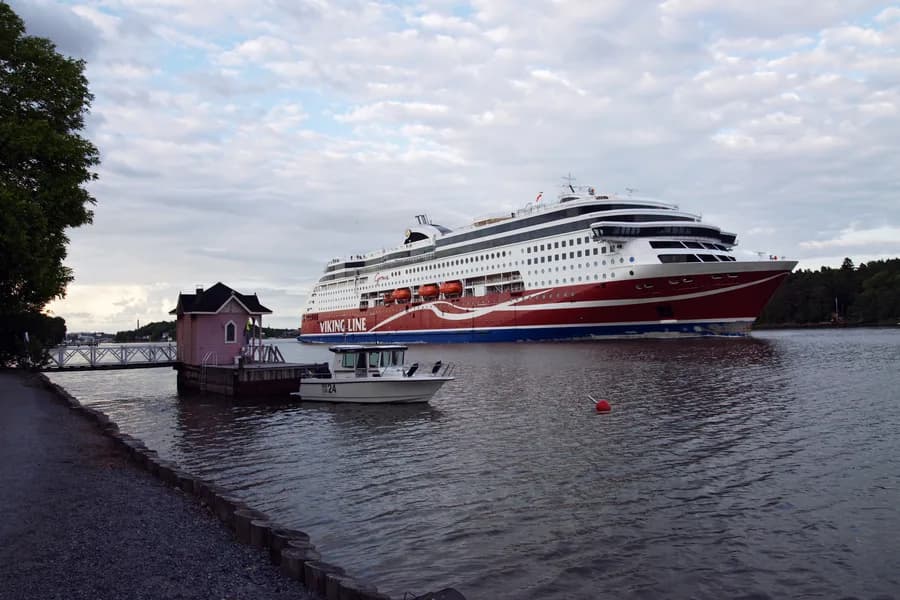
MS Viking Grace is a cruiseferry constructed at STX Europe Turku Shipyard, Finland for the Finland-based ferry company Viking Line. The ship was delivered to her owners on 10 January 2013, and entered service on 13 January 2013. She is the first large-scale passenger ferry to be powered by liquefied natural gas (LNG) as well as being fitted with a rotor sail. Viking Grace replaced MS Isabella (now known as MS Isabelle) on the Turku-Långnäs-Stockholm route. Viking Grace is twinned by MS Viking Glory, which entered service in March 2022. Viking Line and STX Finland made a contract of building the ship (shipyard project number NB 1376) on 25 October 2010, and the contract went into force on 22 December 2010. The contract price was about 240 million euro, and the ship was delivered in January 2013. The contract included an option of an additional ship. Constructing the ship took 2600 man-years. Viking Grace has a length of 218 m (715 ft 3 in), beam of 31.8 m (104 ft 4 in) and maximum summer draft of 6.80 m (22 ft 4 in). The ship has a deadweight tonnage of 6,107 DWT and a gross tonnage of 57,565 GT, which gives maximum passenger capacity for 2,800 people. The vessel has 880 rooms, restaurants, bars, spa and shopping centers. MS Viking Grace also has 1,000 lane meters space for cars and 1,275 lane meters for storage of ro-ro cargo.
Live Tracking
Most time stopped at Stockholm — 41 h across 43 stays.
Derived from the AIS track — runs of near-zero speed (anchored, moored or drifting) snapped to the nearest port. Builds up as we observe the vessel.
Intelligence
Verified reported figure. Band is peer-relative, not official IMO CII.
AIS-derived from our live feed.
Operational Status
Making way at sea speed on its latest broadcast.
Read from the single most-recent AIS broadcast we hold for this hull — we keep no position history, so this is a point-in-time posture, not a dwell inference. Derived in-house from our own AIS feed; weight it by the broadcast age above.
Composite Risk
Some elevated factors — typically age or a lower-graded flag — but no acute ship-specific flag.
A coverage-weighted blend of the 2 components we could read for this hull — the weights renormalise over only the components present, so a thin read is never inflated and a hull is never credited a “safe 0” for a signal it has no row for. This headline is flagged low-confidence (a thin or structural-only read) and should not be treated as a verdict. Higher means riskier. Derived in-house from government-open port-State-control, flag, sanctions and our own vessel data; weight it by the coverage above.
Fleet Management

Visual Archive
Explore More