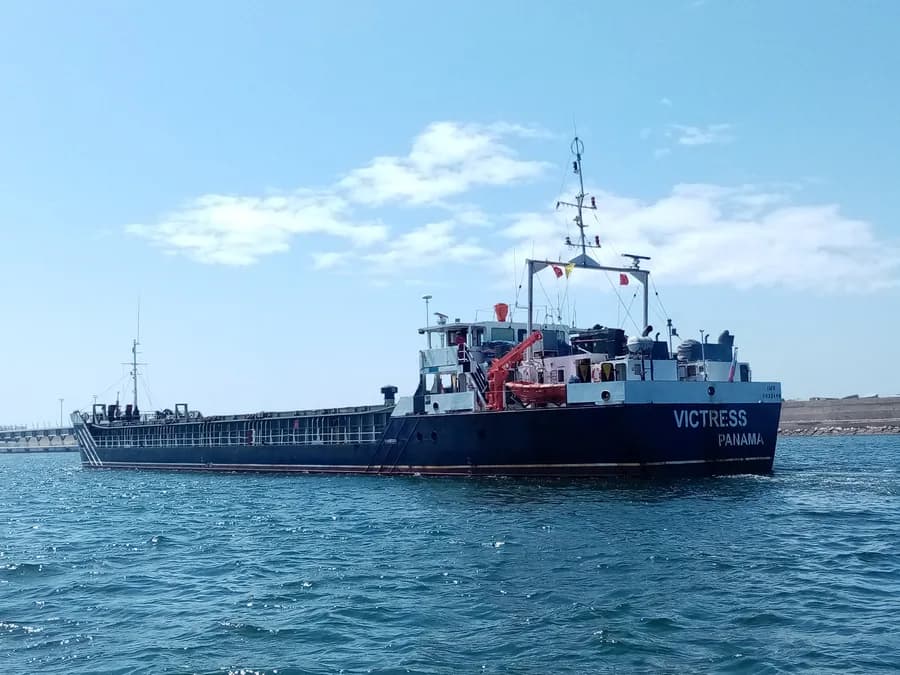
Built by Roßlauer Schiffswerft in 1992
Technical Specifications
Live Tracking
Most time stopped at Maryfield, Bressay — 3 d across 3 stays.
Derived from the AIS track — runs of near-zero speed (anchored, moored or drifting) snapped to the nearest port. Builds up as we observe the vessel.
Intelligence
Compliance
01137–Civil liability for Bunker oil pollution damage cert; 01117–International Oil Pollution Prevention (IOPP); 07105–Fire doors/openings in fire-resisting divisions; 04114– Emergency source of power - Emergency generator; 04103– Emergency, lighting, batteries and switches; 07114 –Remote Means of control (opening, pumps, ventilation, etc.) Machinery spaces
Port-State-Control detentions.
Build Series

Sister hulls share a yard, segment, build year (±1) and deadweight (±3%) — the cleanest comparables for valuation. Derived in-house from our fleet register; coverage is limited to hulls carrying a recorded builder, so a series may be incomplete.
Operational Status
The latest broadcast is too stale or lacks the speed / status to classify.
Read from the single most-recent AIS broadcast we hold for this hull — we keep no position history, so this is a point-in-time posture, not a dwell inference. Derived in-house from our own AIS feed; weight it by the broadcast age above.
Composite Risk
Strong, corroborated adverse evidence — a detention, sanctions exposure or an AIS-gap / behavioural signal.
A coverage-weighted blend of the 4 components we could read for this hull — the weights renormalise over only the components present, so a thin read is never inflated and a hull is never credited a “safe 0” for a signal it has no row for. Higher means riskier. Derived in-house from government-open port-State-control, flag, sanctions and our own vessel data; weight it by the coverage above.
Estimated
Other · summer draught 2.8 m · 8.3 t per cm immersion
Estimate only — modelled from deadweight (deadweight regression) using a first-principles hydrostatic model, not measured hydrostatic tables. The design draught it is anchored to is unreliable across the fleet.
Transparency
Behavioural flags raised against this vessel — each shown with the raw evidence behind it. Derived in-house from data we are entitled to publish; informational, not a determination of wrongdoing.
Stopped transmitting relative to the live feed front
Method: gap measured vs the live feed's own max timestamp, not wall-clock. Source: TheMaritime aisstream.io ingest (ais_positions).
Signals are a current-state view: a flag clears once the vessel stops tripping its detector. These are screening indicators, not a substitute for your own due diligence.
Commercial
Explore More