Technical Specifications
Intelligence
Verified reported figure. Band is peer-relative, not official IMO CII.
Compliance
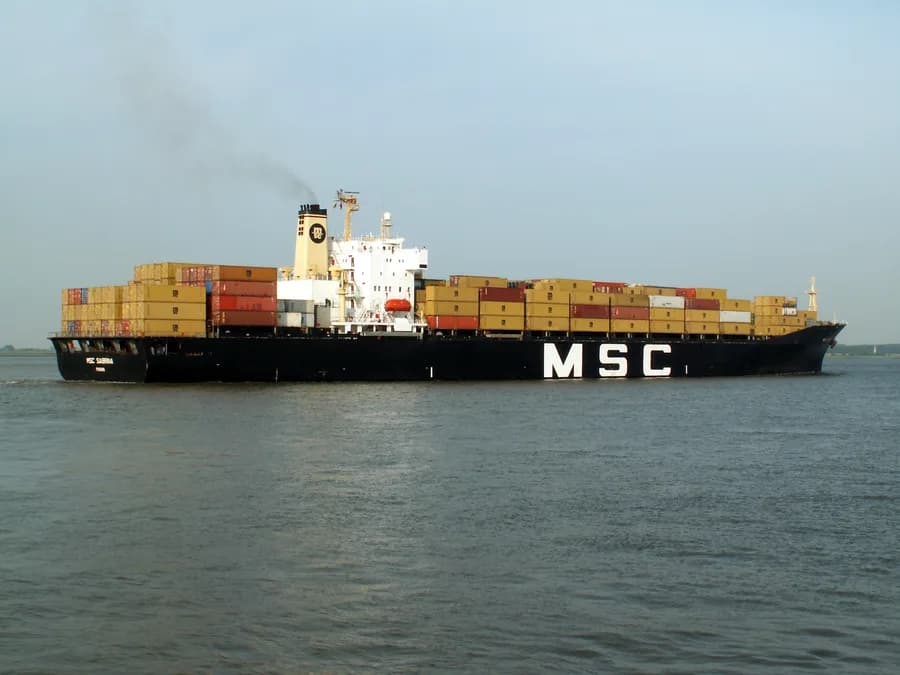
On 8 March 2008, the container vessel "MSC SABRINA" ran aground off section 20 of the Port of Trois-Rivieres, Quebec . Strong winds where present in this area. No ingress of water was observed. No injuries or pollution reported.
On 20 December 2007 off St Nicolas Quebec on the St.Lawrence river, the vessel MSC Sabrina sustained sea suction malfunction. Request was made for ice breaker service.
On 15 September 2007, the down-bound vessel MSC Sabrina reported an engine failure and was drifting. The engine was restored but the vessel had made contact with the side of the channel. No ingress of water was reported.
Recorded marine occurrences naming this vessel.
Composite Risk
Strong, corroborated adverse evidence — a detention, sanctions exposure or an AIS-gap / behavioural signal.
A coverage-weighted blend of the 3 components we could read for this hull — the weights renormalise over only the components present, so a thin read is never inflated and a hull is never credited a “safe 0” for a signal it has no row for. Higher means riskier. Derived in-house from government-open port-State-control, flag, sanctions and our own vessel data; weight it by the coverage above.
Estimated
Container · summer draught 9.6 m · 17.8 t per cm immersion
Estimate only — modelled from deadweight (deadweight regression) using a first-principles hydrostatic model, not measured hydrostatic tables. The design draught it is anchored to is unreliable across the fleet.
density DWT/GT=0.20 is physically implausible for any cargo ship (declared container) — likely a tonnage data error
The declared type conflicts with the class implied by the vessel’s size signals — a possible mis-declaration. Inferred via our shared size-based classifier.
Transparency
Behavioural flags raised against this vessel — each shown with the raw evidence behind it. Derived in-house from data we are entitled to publish; informational, not a determination of wrongdoing.
Declared type contradicts the size-implied class
Method: declared type vs size-implied class (DWT/GT density + beam/LOA fullness). Source: vessel_type_audit (sibling P3#3 job; shared coarse_class classifier).
Signals are a current-state view: a flag clears once the vessel stops tripping its detector. These are screening indicators, not a substitute for your own due diligence.
Commercial
Fleet Management

Visual Archive
Explore More