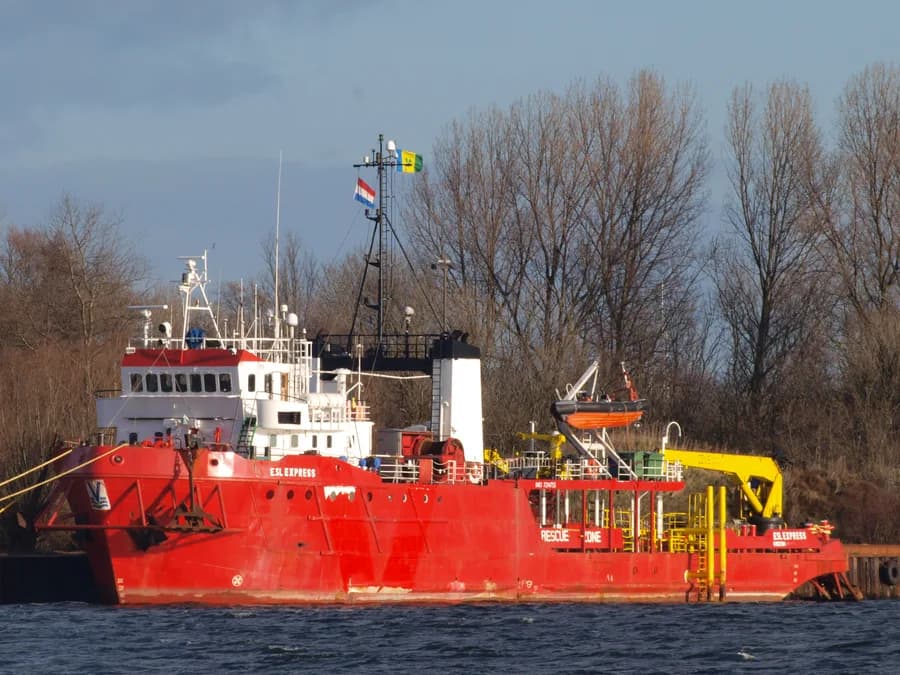
Built by Scheepswerf Pattje in 1972
Technical Specifications
Live Tracking
Most time stopped at Port of Naples — 43 d across 4 stays.
Derived from the AIS track — runs of near-zero speed (anchored, moored or drifting) snapped to the nearest port. Builds up as we observe the vessel.
Intelligence
AIS-derived from our live feed.
Compliance
Fire safety operational booklet; On board training and instructions; Muster list; Maintenance of Life Saving Appliances; Fire doors/openings in fire-resisting divisions; Declaration of Maritime Labour Compliance (Part I and II); Stowage/segregation/packaging dangerous goods; Crew familiarization with Emergency Systems; Maintenance of Fire protection systems; 15 PPM Alarm arrangmts.; Operation/maintenance; Fire pumps and its pipes; Cleanliness of engine room; Seafarers' employment agreement (SEA); Seafarers' employment agreement (SEA); ISM
Cargo Ship Safety Equipment (including exemption); Muster list; Garbage management plan; Ship specific plans for the recovery of persons from the water; Operational readiness of lifesaving appliances; Oil filtering equipment; VHF radio installation
Port-State-Control detentions.
Operational Status
Stopped, anchored or moored on its latest broadcast — parked, not necessarily withdrawn.
Read from the single most-recent AIS broadcast we hold for this hull — we keep no position history, so this is a point-in-time posture, not a dwell inference. Derived in-house from our own AIS feed; weight it by the broadcast age above.
Arrivals, time in port and the load/discharge inferred from the draught change — detected from AIS track history. An open call means the vessel is still in port (no departure observed yet).
Method: each call is a run of fixes inside a port’s geofence confirmed by a stop (or an AIS gap); load/discharge is the sign of the draught delta over the call. Indicative — arrivals before our AIS history began read from the first observation.
Composite Risk
Strong, corroborated adverse evidence — a detention, sanctions exposure or an AIS-gap / behavioural signal.
A coverage-weighted blend of the 3 components we could read for this hull — the weights renormalise over only the components present, so a thin read is never inflated and a hull is never credited a “safe 0” for a signal it has no row for. Higher means riskier. Derived in-house from government-open port-State-control, flag, sanctions and our own vessel data; weight it by the coverage above.

Visual Archive
Explore More