Technical Specifications
Overview
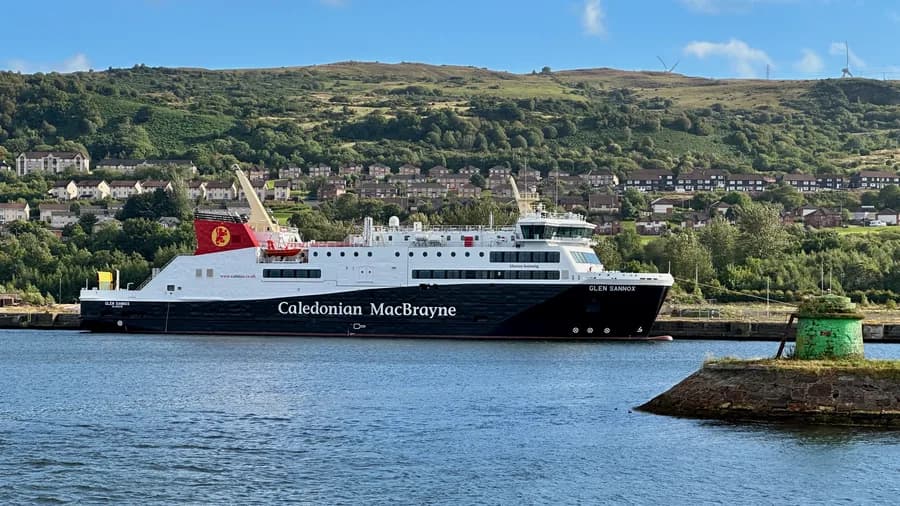
MV Glen Sannox is a car and passenger ferry constructed at Ferguson Marine in Port Glasgow for the Scottish Government asset company CMAL, to lease to its ferry operator Caledonian MacBrayne. Entering service informally to the Isle of Arran on 12 January 2025, formally on 13 January 2025, she is the first of two dual-fuel CalMac ferries, capable of operating on either marine gas oil, or LNG which offers a marked reduction in sulfur dioxide, nitrous oxide and carbon dioxide emissions, the other being the MV Glen Rosa. The ship's name recalls an earlier Arran ferry. The ship's sea trials began in February 2024, and she was moved to Inchgreen Quay in Greenock, freeing the Newark Quay at the shipyard for the launch of MV Glen Rosa. After difficulties in completing the LNG power system, there were further delays. Filling the LNG tank (bunkering) was completed by 18 September, and sea trials using LNG began on 20 September. Manufacturer's sea trials were successfully completed on 23 October. On 19 November 2024, Ferguson Marine announced that the vessel had passed its final certification checks and been issued with a passenger certificate. The ship was handed over to CMAL on 21 November.
Live Tracking
Most time stopped at Lochmaddy — 43 h across 13 stays.
Derived from the AIS track — runs of near-zero speed (anchored, moored or drifting) snapped to the nearest port. Builds up as we observe the vessel.
Intelligence
AIS-derived from our live feed.
Operational Status
Making way at sea speed on its latest broadcast.
Read from the single most-recent AIS broadcast we hold for this hull — we keep no position history, so this is a point-in-time posture, not a dwell inference. Derived in-house from our own AIS feed; weight it by the broadcast age above.
Arrivals, time in port and the load/discharge inferred from the draught change — detected from AIS track history. An open call means the vessel is still in port (no departure observed yet).
Method: each call is a run of fixes inside a port’s geofence confirmed by a stop (or an AIS gap); load/discharge is the sign of the draught delta over the call. Indicative — arrivals before our AIS history began read from the first observation.
Time-in-port summed by port from the AIS-detected port-call history — the ports this vessel has spent the most time at, longest first.
Based on 6 completed calls observed since — open calls (no departure yet) are excluded. The distribution sharpens as AIS history accrues.
Composite Risk
No strong adverse signal on the components we could read for this hull.
A coverage-weighted blend of the 2 components we could read for this hull — the weights renormalise over only the components present, so a thin read is never inflated and a hull is never credited a “safe 0” for a signal it has no row for. This headline is flagged low-confidence (a thin or structural-only read) and should not be treated as a verdict. Higher means riskier. Derived in-house from government-open port-State-control, flag, sanctions and our own vessel data; weight it by the coverage above.
Fleet Management

Visual Archive
Explore More