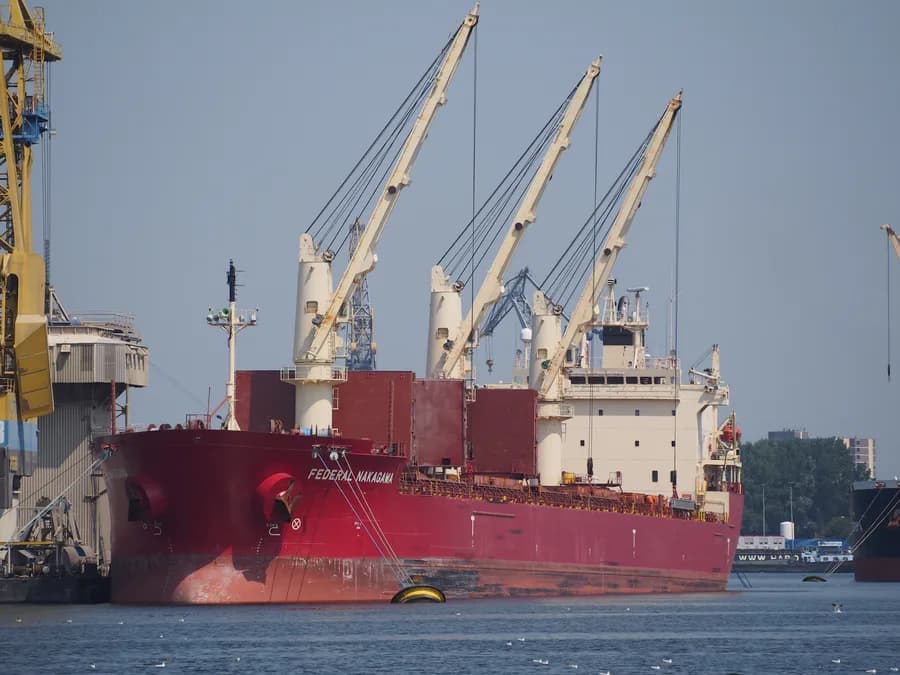
Technical Specifications
Live Tracking
Most time stopped at Petit-Couronne — 3 d across 2 stays.
Derived from the AIS track — runs of near-zero speed (anchored, moored or drifting) snapped to the nearest port. Builds up as we observe the vessel.
Intelligence
How a hull like this loses value with age (today's market). The dot marks this ship at 21 yrs.
Estimate from $/dwt of similar-size, similar-age ships sold in the last 24 months. Indicative, not a certified valuation.
Open the full multi-model valuationVerified reported figure. Band is peer-relative, not official IMO CII.
AIS-derived from our live feed.
Compliance
On 21 June 2026, the bulk carrier "FEDERAL NAKAGAWA", while under the conduct of a pilot, reported having experienced a close quarters situation with 2 personal watercrafts in the St. Lawrence River off Deschaillons-sur-Saint-Laurent, QC.
On 25 March 2026, the bulk carrier "FEDERAL NAKAGAWA", while under the conduct of a pilot, reported a brief loss of its electrical power supply in the St. Lawrence River off Trois-Rivières, QC. The vessel was anchored and repairs were carried out.
On 29 August 2025, the bulk carrier "FEDERAL NAKAGAWA", while under the conduct of a pilot, reported having experienced a close quarters situation with the pleasure craft "QC9216902" in the St. Lawrence River off Saint-Nicolas, QC.
On 20 November 2023, the "FEDERAL NAKAGAWA", while under the conduct of a pilot, reported having sustained a total failure of its engine upon departure from Thunder Bay, ON. The vessel was anchored off the harbour for repairs, and once effected, resumed its voyage.
On 16 June 2020, the bulk carrier "FEDERAL NAKAGAWA", whilst under the conduct of a pilot, reported striking the dock in the Port de Valleyfield, QC. A fuel oil leak developed on the main engine back flush filter following the striking. The crew carried out repairs and the vessel resumed its intended voyage.
On 26 May 2020, the bulk carrier "FEDERAL NAKAGAWA", whilst berthed in Baie-Comeau, QC, reported that mooring ropes were entangled around its propeller. The mooring ropes were removed using divers.
Recorded marine occurrences naming this vessel.
Operational Status
The latest broadcast is too stale or lacks the speed / status to classify.
Read from the single most-recent AIS broadcast we hold for this hull — we keep no position history, so this is a point-in-time posture, not a dwell inference. Derived in-house from our own AIS feed; weight it by the broadcast age above.
Arrivals, time in port and the load/discharge inferred from the draught change — detected from AIS track history. An open call means the vessel is still in port (no departure observed yet).
Method: each call is a run of fixes inside a port’s geofence confirmed by a stop (or an AIS gap); load/discharge is the sign of the draught delta over the call. Indicative — arrivals before our AIS history began read from the first observation.
Time-in-port summed by port from the AIS-detected port-call history — the ports this vessel has spent the most time at, longest first.
Based on 1 completed call observed since — open calls (no departure yet) are excluded. The distribution sharpens as AIS history accrues.
Composite Risk
Strong, corroborated adverse evidence — a detention, sanctions exposure or an AIS-gap / behavioural signal.
A coverage-weighted blend of the 3 components we could read for this hull — the weights renormalise over only the components present, so a thin read is never inflated and a hull is never credited a “safe 0” for a signal it has no row for. Higher means riskier. Derived in-house from government-open port-State-control, flag, sanctions and our own vessel data; weight it by the coverage above.
Estimated
Bulker · summer draught 6.3 m · 43.7 t per cm immersion
Estimate only — modelled from deadweight (deadweight regression) using a first-principles hydrostatic model, not measured hydrostatic tables. The design draught it is anchored to is unreliable across the fleet.
density DWT/GT=1.77 is consistent with declared bulker
Declared type is consistent with the class implied by the vessel’s size signals. Inferred via our shared size-based classifier.
Transparency
Behavioural flags raised against this vessel — each shown with the raw evidence behind it. Derived in-house from data we are entitled to publish; informational, not a determination of wrongdoing.
Stopped transmitting relative to the live feed front
Method: gap measured vs the live feed's own max timestamp, not wall-clock. Source: TheMaritime aisstream.io ingest (ais_positions).
Signals are a current-state view: a flag clears once the vessel stops tripping its detector. These are screening indicators, not a substitute for your own due diligence.
Commercial

Visual Archive
Explore More