Technical Specifications
Overview
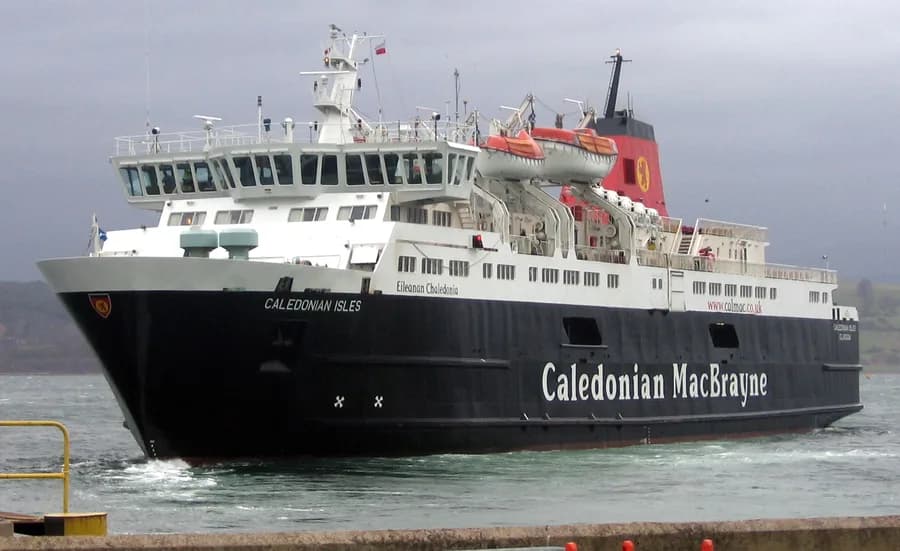
MV Caledonian Isles, usually referred to locally as Caley Isles, is one of the largest ships operated by Caledonian MacBrayne (CalMac), which runs ferries to the Hebridean and Clyde Islands of Scotland. Caledonian Isles serves the Isle of Arran on the Ardrossan to Brodick route. As its CalMac's busiest route, Caledonian Isles has the largest passenger capacity in the fleet, and can carry up to 1000 passengers and 110 cars (reduced to about 90 wider modern cars), with a crossing time of 55 minutes. She is used extensively by day-trippers to the Isle of Arran during the summer.
Live Tracking
Most time stopped at Ardrossan — 13 d across 118 stays.
Derived from the AIS track — runs of near-zero speed (anchored, moored or drifting) snapped to the nearest port. Builds up as we observe the vessel.
Intelligence
Operational Status
Stopped, anchored or moored on its latest broadcast — parked, not necessarily withdrawn.
Read from the single most-recent AIS broadcast we hold for this hull — we keep no position history, so this is a point-in-time posture, not a dwell inference. Derived in-house from our own AIS feed; weight it by the broadcast age above.
Arrivals, time in port and the load/discharge inferred from the draught change — detected from AIS track history. An open call means the vessel is still in port (no departure observed yet).
Method: each call is a run of fixes inside a port’s geofence confirmed by a stop (or an AIS gap); load/discharge is the sign of the draught delta over the call. Indicative — arrivals before our AIS history began read from the first observation.
Time-in-port summed by port from the AIS-detected port-call history — the ports this vessel has spent the most time at, longest first.
Based on 46 completed calls observed since — open calls (no departure yet) are excluded. The distribution sharpens as AIS history accrues.
Composite Risk
Multiple adverse factors, or a hard ship-specific signal, lift this hull above the fleet norm.
A coverage-weighted blend of the 2 components we could read for this hull — the weights renormalise over only the components present, so a thin read is never inflated and a hull is never credited a “safe 0” for a signal it has no row for. This headline is flagged low-confidence (a thin or structural-only read) and should not be treated as a verdict. Higher means riskier. Derived in-house from government-open port-State-control, flag, sanctions and our own vessel data; weight it by the coverage above.
Fleet Management

Visual Archive
Explore More