Technical Specifications
Overview
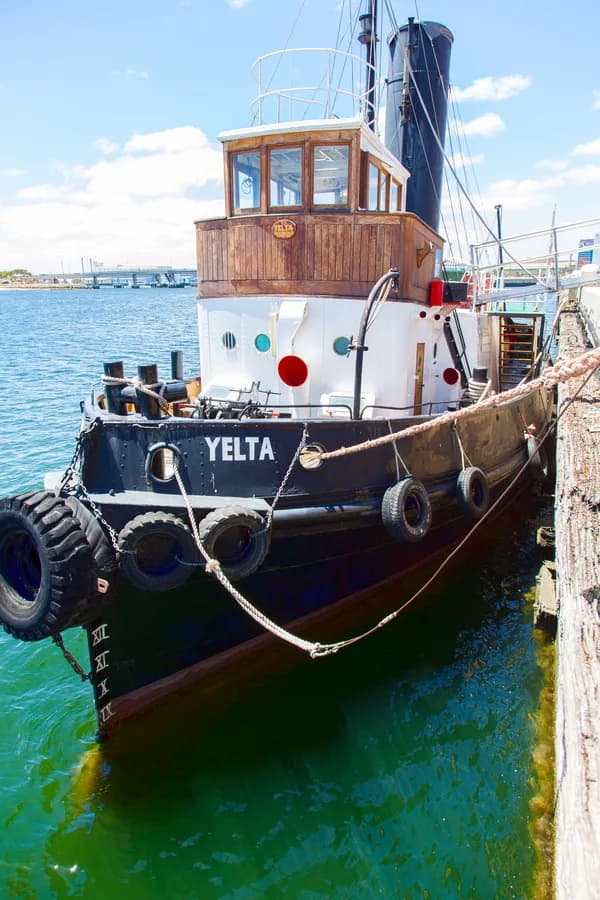
Yelta is a steam tug which operated in the Australian state of South Australia from 1949 to 1976 within both the Port River and the waters of Gulf St Vincent immediately adjoining the river's mouth. After being laid up for about nine years, she was purchased in 1985 by the Government of South Australia for addition to the collection of the South Australian Maritime Museum as a museum ship. As of 1985, she was considered to be the only remaining steam-powered tug operating within Australian waters. Yelta was built at the Cockatoo Island Dockyard in Sydney, during 1948 by the Cockatoo Docks & Engineering Company for Ritch & Smith of Port Adelaide, South Australia. After an 11-day voyage from Sydney, Yelta arrived in Port Adelaide on 22 February 1949. Until her retirement in 1976, she assisted vessels to and from docks and other facilities within the Port River. She also assisted in refloating vessels that ran aground within the Port River such as Eastwave in 1950, Caltex Bombay in 1952, and Ulooloo and Trykori in 1953. Yelta was retired from service in November 1976. The Port Adelaide branch of the National Trust of South Australia purchased the vessel with the objective of making "a feature of a maritime museum on a lease it holds on land on Cruickshank corner near the Birkenhead Bridge.
Composite Risk
Multiple adverse factors, or a hard ship-specific signal, lift this hull above the fleet norm.
A coverage-weighted blend of the single component we could read for this hull; the weights renormalise over only the components present, so a thin read is never inflated and a hull is never credited a “safe 0” for a signal it has no row for. This headline is flagged low-confidence (a thin or structural-only read) and should not be treated as a verdict. Higher means riskier. Derived in-house from government-open port-State-control, flag, sanctions and our own vessel data; weight it by the coverage above.
Commercial
Price it in the Route Planner between any two commercial ports: ballast and laden legs, two fuels at live bunker prices, port and canal costs, the weather on the way, and the TCE set against the market.

Visual Archive