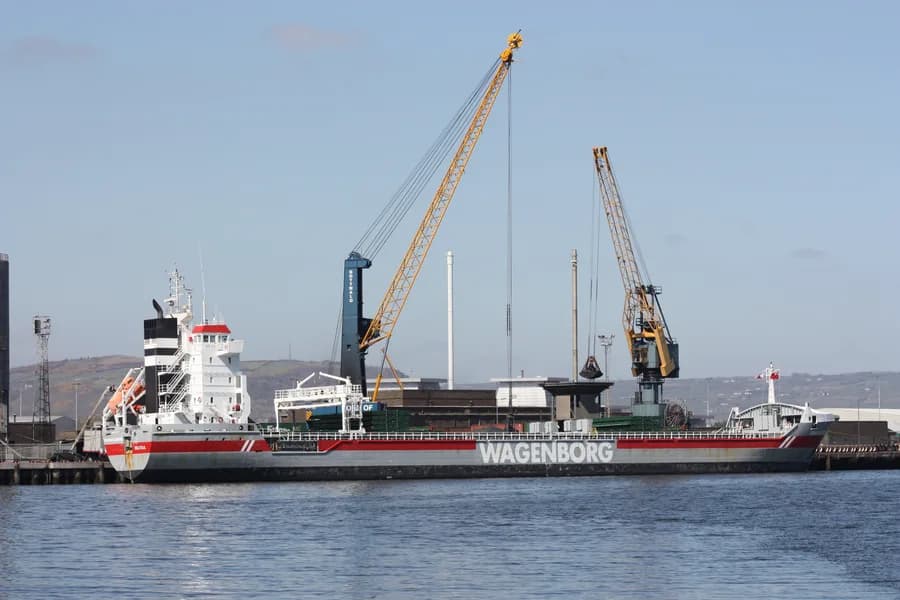
Technical Specifications
Live Tracking
Intelligence
Verified reported figure. Band is peer-relative, not official IMO CII.
AIS-derived from our live feed.
Compliance
On 31 October 2018, the general cargo vessel "VANCOUVERBORG" sustained a total failure of the main engine near section 44 of the Port de Montréal, QC. The crew dropped the anchor to stop the vessel.
On 29 October 2018, the general cargo vessel "VANCOUVERBORG" reported a leak in the main engine's cooling system 28.4 nautical miles NNE of Saint-Anne-des-Monts, QC. The crew made repairs and the vessel resumed its voyage.
On approaching lower Beauharnois lock, the VANCOUVERBORG experienced a propeller pitch failure. The controllable pitch system automatically turned to reverse mode and the vessel suddenly yawed. The vessel touched the bullnoze with no apparent damage.
Recorded marine occurrences naming this vessel.
Build Series


Sister hulls share a yard, segment, build year (±1) and deadweight (±3%) — the cleanest comparables for valuation. Derived in-house from our fleet register; coverage is limited to hulls carrying a recorded builder, so a series may be incomplete.
Operational Status
Making way at sea speed on its latest broadcast.
Read from the single most-recent AIS broadcast we hold for this hull — we keep no position history, so this is a point-in-time posture, not a dwell inference. Derived in-house from our own AIS feed; weight it by the broadcast age above.
Arrivals, time in port and the load/discharge inferred from the draught change — detected from AIS track history. An open call means the vessel is still in port (no departure observed yet).
Method: each call is a run of fixes inside a port’s geofence confirmed by a stop (or an AIS gap); load/discharge is the sign of the draught delta over the call. Indicative — arrivals before our AIS history began read from the first observation.
Time-in-port summed by port from the AIS-detected port-call history — the ports this vessel has spent the most time at, longest first.
Based on 10 completed calls observed since — open calls (no departure yet) are excluded. The distribution sharpens as AIS history accrues.
Composite Risk
Multiple adverse factors, or a hard ship-specific signal, lift this hull above the fleet norm.
A coverage-weighted blend of the 2 components we could read for this hull — the weights renormalise over only the components present, so a thin read is never inflated and a hull is never credited a “safe 0” for a signal it has no row for. This headline is flagged low-confidence (a thin or structural-only read) and should not be treated as a verdict. Higher means riskier. Derived in-house from government-open port-State-control, flag, sanctions and our own vessel data; weight it by the coverage above.
Estimated
Other · summer draught 7.2 m · 21.9 t per cm immersion
Estimate only — modelled from deadweight (deadweight regression) using a first-principles hydrostatic model, not measured hydrostatic tables. The design draught it is anchored to is unreliable across the fleet.
Commercial

Visual Archive
Explore More