Technical Specifications
Overview
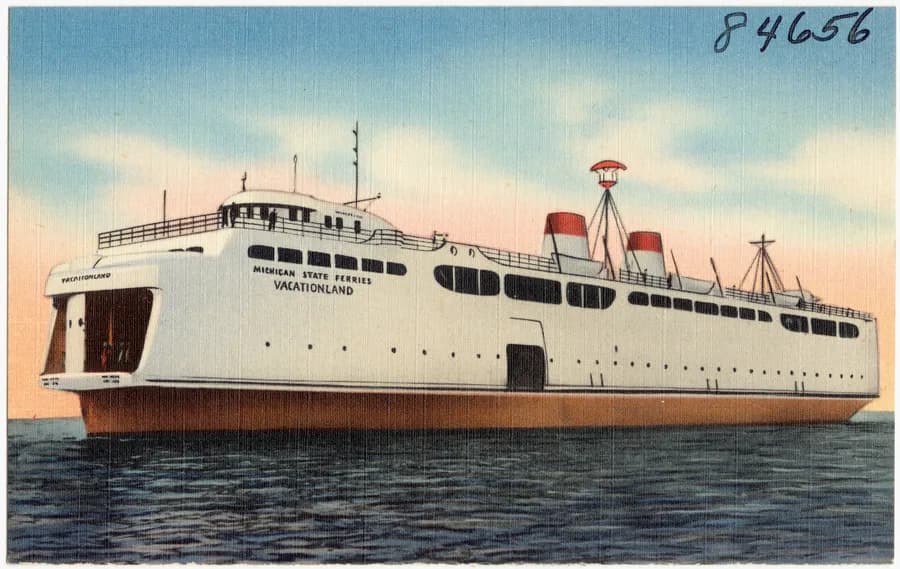
Vacationland was an American double-ended automobile ferry, built by Great Lakes Engineering Works for the Michigan State Highway Department. She was built to operate the route from St. Ignace to Mackinaw City through the Straits of Mackinac year-round, and was equipped with powerful engines and a reinforced hull to break through heavy ice. Vacationland was launched in 1951, and entered service in 1952. She was the final ferry built for the St. Ignace–Mackinaw City service, which was replaced by the Mackinac Bridge in 1957. Following the opening of the Mackinac Bridge in 1957, the Vacationland was laid up until 1960, when she was sold to a private operator on Lake Erie as the Jack Dalton. She was repossessed by the State of Michigan for nonpayment shortly afterwards, and in 1961 she began service on the St. Lawrence River as the Père Nouvel, inaugurating a popular route between Baie-Comeau and Pointe-au-Père, Quebec. In 1967, she was sold to BC Ferries in British Columbia and renamed the Sunshine Coast Queen. She was the first double-ended ferry in the BC Ferries fleet, a design that the service adopted for all new ferries after her. High operating costs and rising fuel prices forced BC Ferries to retire the vessel, affectionately known as the "Susy Q," in 1977.
Composite Risk
Multiple adverse factors, or a hard ship-specific signal, lift this hull above the fleet norm.
A coverage-weighted blend of the single component we could read for this hull; the weights renormalise over only the components present, so a thin read is never inflated and a hull is never credited a “safe 0” for a signal it has no row for. This headline is flagged low-confidence (a thin or structural-only read) and should not be treated as a verdict. Higher means riskier. Derived in-house from government-open port-State-control, flag, sanctions and our own vessel data; weight it by the coverage above.
Commercial
Price it in the Route Planner between any two commercial ports: ballast and laden legs, two fuels at live bunker prices, port and canal costs, the weather on the way, and the TCE set against the market.
Fleet Management

Visual Archive