Technical Specifications
Overview
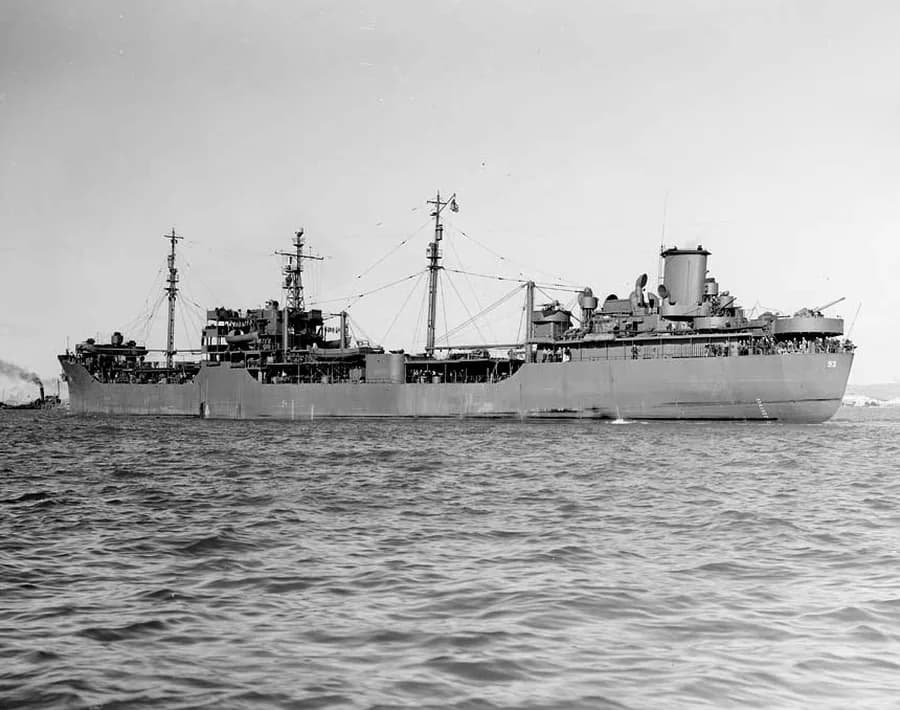
USS Soubarissen (AO-93) was an Escambia-class fleet oiler converted to a water tanker, named for a chief of the "Neutral" Indian Nations which, although a part of the Iroquois confederation, were called "neutral" by the French because they took no part in the wars of the Iroquois and Hurons. The area he governed included the oil fields of northwestern Pennsylvania and western New York. The knowledge of the oil seepages there was well known among the Indians, and it was declared neutral ground so all Indians could obtain oil for medicinal and domestic purposes without danger or interference. In 1627, Joseph de La Roche Daillon heard of the oil springs and made an expedition to visit them. He was kindly received by Chief Soubarissen, shown the oil seepages, and duly reported his observations to his superiors. These observations contributed largely to the interest in the petroleum resources of the Pennsylvania region. Soubarissen, was laid down as SS Mission Santa Ana on 19 June 1944 by Marinship Corporation of Sausalito, California as a Maritime Commission type T2-SE-A2 tanker hull with a cargo capacity of 140,000 barrels (22,000 m3), under Maritime Commission contract (MC hull 1828); launched on 12 August 1944; sponsored by Mrs. Andrew F. Carter; acquired by the Navy and commissioned on 5 January 1945.
Composite Risk
Multiple adverse factors, or a hard ship-specific signal, lift this hull above the fleet norm.
A coverage-weighted blend of the single component we could read for this hull; the weights renormalise over only the components present, so a thin read is never inflated and a hull is never credited a “safe 0” for a signal it has no row for. This headline is flagged low-confidence (a thin or structural-only read) and should not be treated as a verdict. Higher means riskier. Derived in-house from government-open port-State-control, flag, sanctions and our own vessel data; weight it by the coverage above.
Commercial
Price it in the Route Planner between any two commercial ports: ballast and laden legs, two fuels at live bunker prices, port and canal costs, the weather on the way, and the TCE set against the market.

Visual Archive