Technical Specifications
Overview
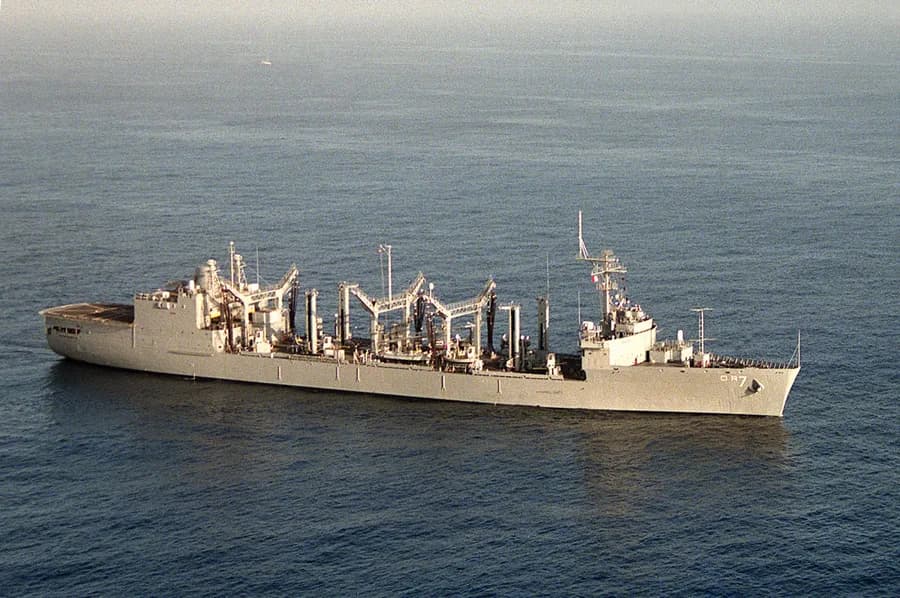
USS Roanoke (AOR-7) was a Wichita-class replenishment oiler of the United States Navy. She was named after the city of Roanoke, Virginia and the Roanoke River, in keeping with the naming convention of her class. Built by the National Steel and Shipbuilding Company, of San Diego, California, she was launched on 7 December 1974, and commissioned on 30 October 1976. Roanoke sailed for her first deployment to the western Pacific in January 1978, where she supported various USN units, including the USS Enterprise (CVN-65), USS Long Beach (CGN-9) and USS Truxtun (CGN-35) during the Australian leg of their deployment, docking in Fremantle, Western Australia from 7–10 August 1978. After 10 months away USS Roanoke finally returned to her homeport of San Francisco, California, in October. This set the pattern for the next twelve years, as she was deployed on a voyage to the western Pacific and Indian Ocean, each lasting six to eight months, every year. Between January 1991 and August 1993 she sailed on two deployments to the Persian Gulf supporting Operation Desert Storm. She made one last deployment to the western Pacific in June to December 1994, before being decommissioned. Roanoke was decommissioned on 6 October 1995, and struck from the Naval Vessel Register the same day.
Composite Risk
Multiple adverse factors, or a hard ship-specific signal, lift this hull above the fleet norm.
A coverage-weighted blend of the single component we could read for this hull; the weights renormalise over only the components present, so a thin read is never inflated and a hull is never credited a “safe 0” for a signal it has no row for. This headline is flagged low-confidence (a thin or structural-only read) and should not be treated as a verdict. Higher means riskier. Derived in-house from government-open port-State-control, flag, sanctions and our own vessel data; weight it by the coverage above.
Commercial
Price it in the Route Planner between any two commercial ports: ballast and laden legs, two fuels at live bunker prices, port and canal costs, the weather on the way, and the TCE set against the market.

Visual Archive