Technical Specifications
Overview
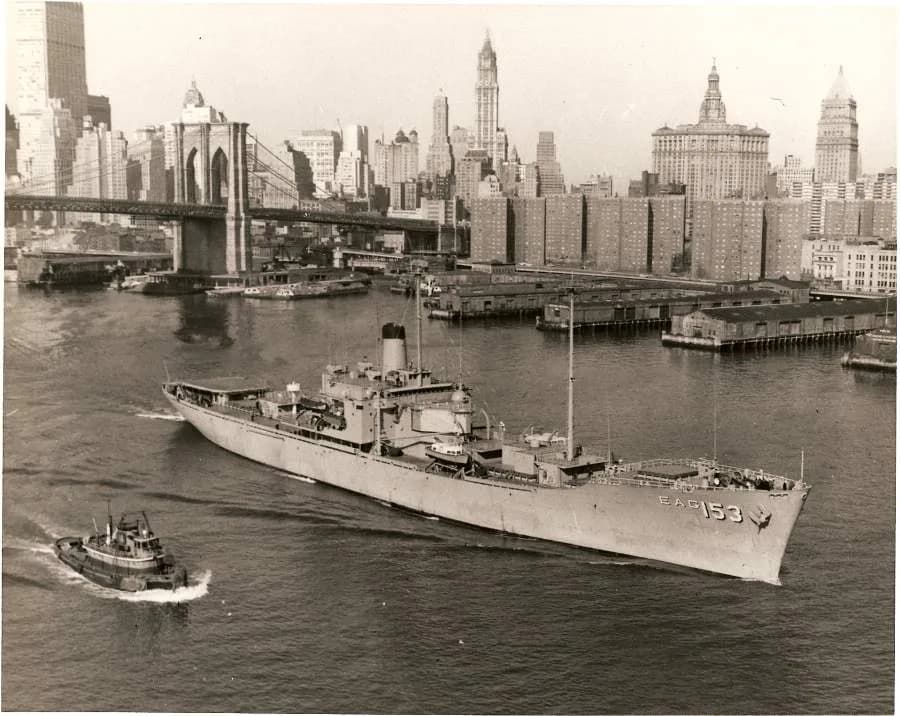
Compass Island (EAG-153) was launched 24 October 1953 as Garden Mariner by the New York Shipbuilding Corporation, Camden, New Jersey and sponsored by Mrs. H. A. Smith. Acquired by the Navy 29 March 1956 and commissioned 3 December 1956. Compass Island was one of two ships, the other being USS Observation Island (E-AG-154), converted and classified as navigational research test vessels under the Polaris Missile system budget. Compass Island's conversion was at an estimated cost of $19,600,000. The ship's mission was to assist in the development and evaluation of a navigation system independent of shore-based and celestial aids, a necessary adjunct of the ballistic missile program. She operated along the eastern seaboard testing equipment and training personnel until 13 March 1958 when she sailed from New York for experiments in the Mediterranean, returning to New York 17 April to resume her east coast operations. A dramatic example of her work was provided when USS Nautilus (SSN-571), using the Shipboard Inertial Navigation System (SINS) first tested by Compass Island in 1957, made a submerged cruise beneath the Arctic ice pack, touching exactly at the North Pole on 3 August 1958. The INS hardware was the N6A-1 built by North American Aviation, a naval modification of the N6A designed for the Navaho cruise missile.
Composite Risk
Multiple adverse factors, or a hard ship-specific signal, lift this hull above the fleet norm.
A coverage-weighted blend of the single component we could read for this hull; the weights renormalise over only the components present, so a thin read is never inflated and a hull is never credited a “safe 0” for a signal it has no row for. This headline is flagged low-confidence (a thin or structural-only read) and should not be treated as a verdict. Higher means riskier. Derived in-house from government-open port-State-control, flag, sanctions and our own vessel data; weight it by the coverage above.
Commercial
Price it in the Route Planner between any two commercial ports: ballast and laden legs, two fuels at live bunker prices, port and canal costs, the weather on the way, and the TCE set against the market.

Visual Archive