Technical Specifications
Overview
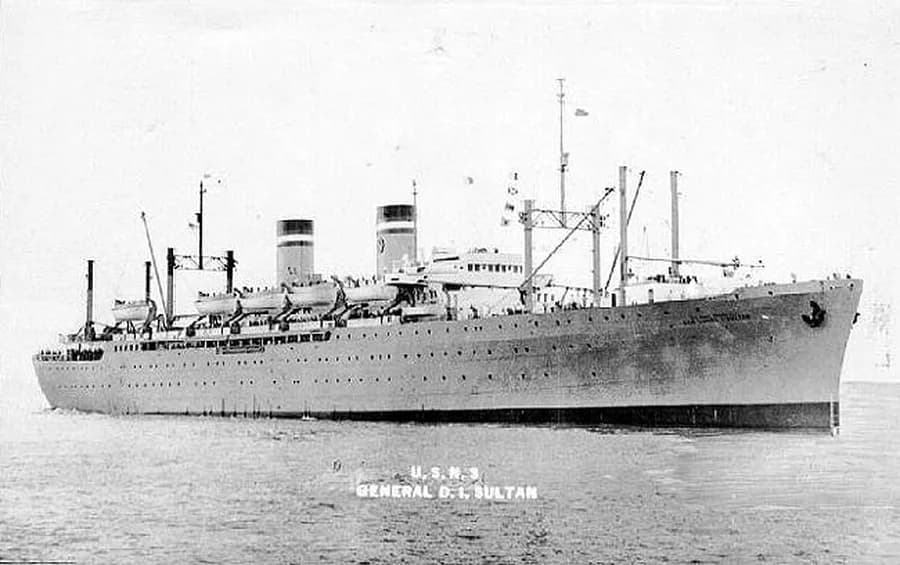
USS Admiral W. S. Benson (AP-120) began as an unnamed transport, AP-120, that was laid down on 10 December 1942 at Alameda, California by the Bethlehem-Alameda Shipbuilding Corp., under a Maritime Commission contract (MC hull 678). She was named Admiral W. S. Benson (AP-120) on 20 October 1943 and launched on 22 November 1943; sponsored by Miss Dorothy Lucille Benson, granddaughter of the late Admiral William S. Benson. She was accepted from the Maritime Commission on 23 August 1944 and commissioned the same day. After fitting out and provisioning at the Naval Supply Depot, Oakland, California, Admiral W. S. Benson stood out of San Francisco Bay on 1 September 1944 for San Pedro, to commence shakedown training. During the next two weeks, the transport carried out daily exercises and gunnery runs in the vicinity of Santa Catalina, San Nicholas, and San Clemente islands. Upon completion of this training, the ship underwent post-shakedown availability at the Todd Shipyard in Wilmington, Los Angeles, before she commenced work at the Small Craft Training Center, Terminal Island, serving a tour of temporary duty in connection with the training of attack transport (APA) crews. Over the next two weeks, the ship operated locally with crews from USS Hinsdale, USS Lanier, USS St. Mary's and USS Allendale. Admiral W. S.
Composite Risk
Multiple adverse factors, or a hard ship-specific signal, lift this hull above the fleet norm.
A coverage-weighted blend of the single component we could read for this hull; the weights renormalise over only the components present, so a thin read is never inflated and a hull is never credited a “safe 0” for a signal it has no row for. This headline is flagged low-confidence (a thin or structural-only read) and should not be treated as a verdict. Higher means riskier. Derived in-house from government-open port-State-control, flag, sanctions and our own vessel data; weight it by the coverage above.
Commercial
Price it in the Route Planner between any two commercial ports: ballast and laden legs, two fuels at live bunker prices, port and canal costs, the weather on the way, and the TCE set against the market.

Visual Archive