Technical Specifications
Overview
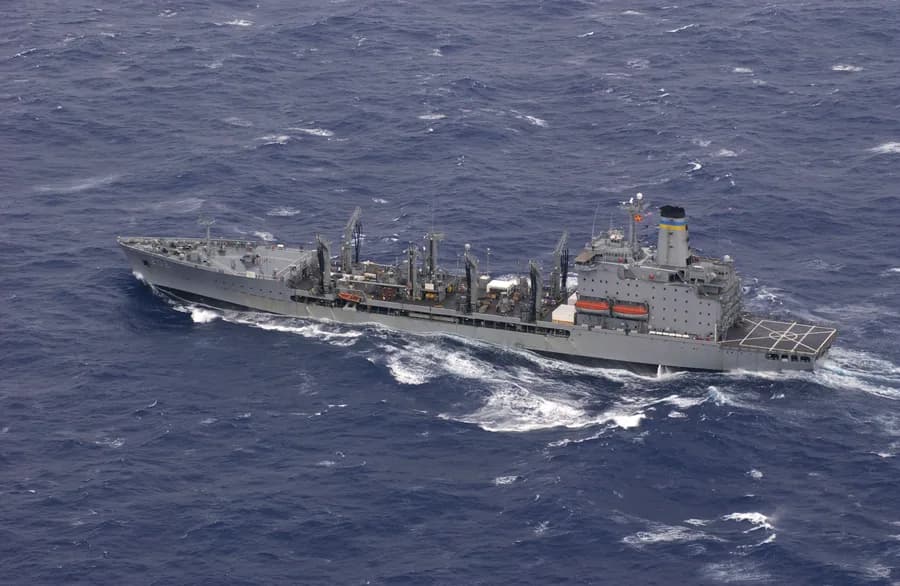
USNS Yukon (T-AO-202) is a Henry J. Kaiser-class underway replenishment oiler operated by the Military Sealift Command to support ships of the United States Navy. Yukon, the sixteenth ship of the Henry J. Kaiser class, was laid down at Avondale Shipyard, Inc., at New Orleans, Louisiana, on 13 May 1991 and launched on 6 February 1993. She entered non-commissioned U.S. Navy service under the control of the Military Sealift Command with a primarily civilian crew on 25 March 1994. She serves in the United States Pacific Fleet. On 27 February 2000, Yukon collided with a smaller civilian cargo ship while entering the port of Dubai in the Persian Gulf. On 13 July 2000, Yukon collided with the amphibious transport dock USS Denver (LPD-9) during an underway replenishment about 180 nautical miles (330 km) west of Hawaii. No one on either ship was injured, and there were no fuel leaks, but Yukon suffered major damage, including several large holes and dents above the water line on her starboard quarter, while a 40-foot (12.2 m) hole was torn in Denver's bow from the second deck to the waterline. The investigation into the accident found Denver responsible. Both ships went to the Pearl Harbor Naval Shipyard at Pearl Harbor, Hawaii, for repairs. Yukon then transited to San Francisco, California, for further repairs at the same time as her scheduled routine overhaul.
Composite Risk
Multiple adverse factors, or a hard ship-specific signal, lift this hull above the fleet norm.
A coverage-weighted blend of the single component we could read for this hull; the weights renormalise over only the components present, so a thin read is never inflated and a hull is never credited a “safe 0” for a signal it has no row for. This headline is flagged low-confidence (a thin or structural-only read) and should not be treated as a verdict. Higher means riskier. Derived in-house from government-open port-State-control, flag, sanctions and our own vessel data; weight it by the coverage above.
Commercial
Price it in the Route Planner between any two commercial ports: ballast and laden legs, two fuels at live bunker prices, port and canal costs, the weather on the way, and the TCE set against the market.

Visual Archive