Technical Specifications
Overview
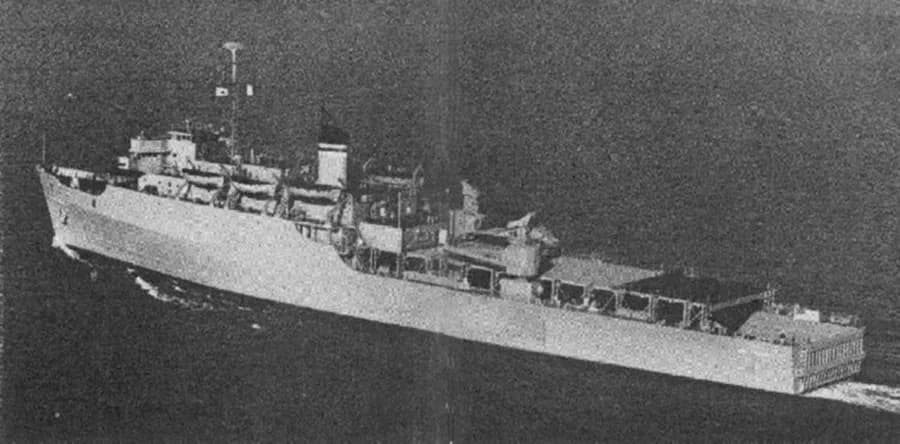
USNS Point Barrow (T-AKD-1) was a one-of-a-kind "Cargo Ship Dock." She was the lone ship in her class, named for Point Barrow (the northernmost point in Alaska). Point Barrow was laid down 18 September 1956 by Maryland Drydock and Shipbuilding Company of Baltimore; launched 25 May 1957; sponsored by Mrs. Ruthven E. Libbey; and delivered to the Military Sea Transportation Service (MSTS) 28 May 1958, where she was placed in service the following day. Especially designed for Arctic operations, Point Barrow was constructed along the general lines of a landing ship dock, but with strengthened hull and bow, and special insulation. After providing logistic support for U.S. forces in the Arctic, in 1962, Point Barrow transported huge fixed array radar antennas for the USS Enterprise and USS Long Beach to the East Coast. After extensive modification in June 1965, Point Barrow carried Saturn rocket parts and stages from California to the Kennedy Space Center for NASA’s Apollo space flight program. T–AKD–1 also ferried LCMs to Southeast Asia in 1968 and 1969. Reclassified a "Deep Submergence Support Ship" and renamed USS Point Loma (AGDS-2) circa 1974, she was ultimately placed out of service and struck from the Naval Vessel Register 28 September 1993.
Composite Risk
Multiple adverse factors, or a hard ship-specific signal, lift this hull above the fleet norm.
A coverage-weighted blend of the single component we could read for this hull; the weights renormalise over only the components present, so a thin read is never inflated and a hull is never credited a “safe 0” for a signal it has no row for. This headline is flagged low-confidence (a thin or structural-only read) and should not be treated as a verdict. Higher means riskier. Derived in-house from government-open port-State-control, flag, sanctions and our own vessel data; weight it by the coverage above.
Commercial
Price it in the Route Planner between any two commercial ports: ballast and laden legs, two fuels at live bunker prices, port and canal costs, the weather on the way, and the TCE set against the market.

Visual Archive