Technical Specifications
Overview
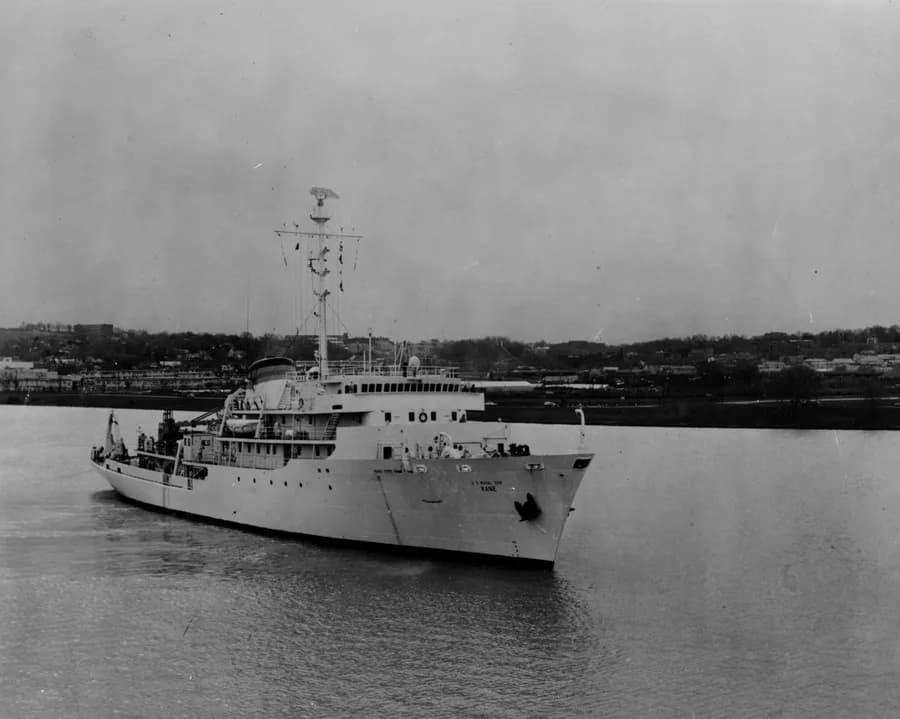
USNS Kane (T-AGS-27) was a Silas Bent-class survey ship acquired by the United States Navy and delivered to Military Sealift Command in 1967. Kane spent her career performing oceanographic surveys. The ship was equipped with the Oceanographic Data Acquisition System (ODAS) as were oceanographic survey ships USNS Silas Bent (T-AGS-26) and USNS Wilkes (T-AGS-33). Kane was launched 20 November 1965 by the Christy Corporation, Sturgeon Bay, Wisconsin; sponsored by Mrs. Harold T. Duetermann, wife of Vice Admiral Deutermann; assigned to Military Sea Transportation Service; and placed in service 26 May 1967 for scientific operations in the Atlantic. Bruce Heezen was the chief scientist on Kane's maiden research voyage, a four-month survey of fracture zones to determine what route and through what periods of geologic time North America separated from Europe and Africa. Cartographer Marie Tharp was also on board and worked on revising the North Atlantic physiographic diagram while also producing a new physiographic map of the Pacific Ocean floor. Besides conducting coastal hydrographic and oceanographic surveys, Kane also tended small survey craft, helicopters, and Marine Corps survey teams. She was capable of compiling and printing finished charts on the spot to meet fleet and landing force requirements and had accommodations for scientists.
Composite Risk
Multiple adverse factors, or a hard ship-specific signal, lift this hull above the fleet norm.
A coverage-weighted blend of the single component we could read for this hull; the weights renormalise over only the components present, so a thin read is never inflated and a hull is never credited a “safe 0” for a signal it has no row for. This headline is flagged low-confidence (a thin or structural-only read) and should not be treated as a verdict. Higher means riskier. Derived in-house from government-open port-State-control, flag, sanctions and our own vessel data; weight it by the coverage above.
Commercial
Price it in the Route Planner between any two commercial ports: ballast and laden legs, two fuels at live bunker prices, port and canal costs, the weather on the way, and the TCE set against the market.

Visual Archive