Technical Specifications
Overview
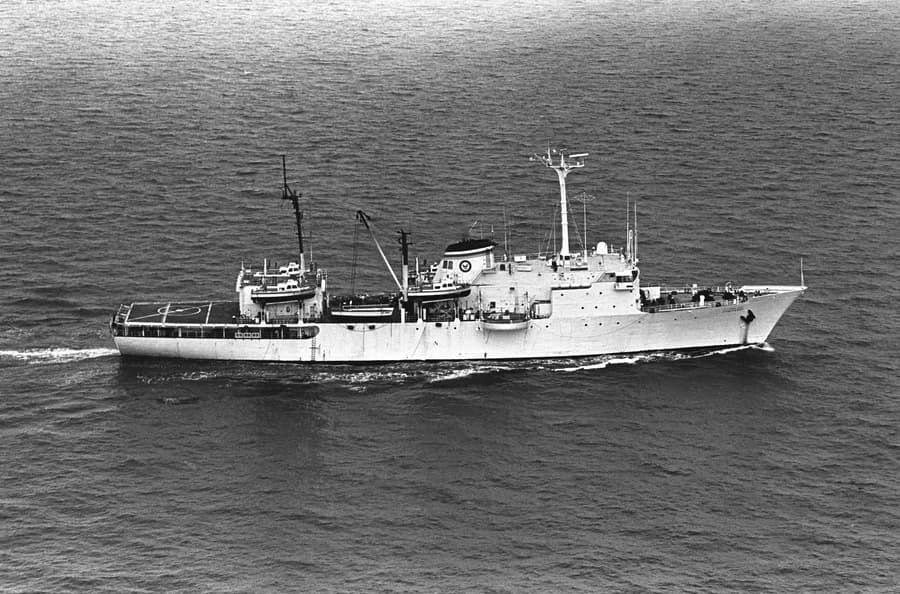
USNS Chauvenet (T-AGS-29) was a multi-function (littoral, coastal and deep ocean) survey ship laid down on 24 May 1967, at Upper Clyde Shipbuilding Corp., Glasgow, Scotland. The ship was the second survey ship, Chauvenet (AGS-11) being the first, named for William Chauvenet (1820–1870). He was instrumental in the founding of the United States Naval Academy at Annapolis, MD. The mathematics department of the US Naval Academy in Annapolis was founded by Chauvenet and is housed in Chauvenet Hall. Chauvenet was launched on 13 May 1968, delivered to the US Navy, 13 November 1970 and placed in service with the Military Sealift Command (MSC) as USNS Chauvenet (T-AGS-29). The ship conducted coastal hydrographic and topographic surveys under the technical direction of the Oceanographer of the Navy through the U.S. Naval Oceanographic Office (NAVOCEANO). The ship was assigned to the Pacific for surveys, sister ship Harkness (T-AGS-32) was assigned Atlantic duties, doing so until inactivated in November 1992. In February 1996 the Navy turned title to the ship over to the Maritime Administration (MARAD). MARAD had the ship altered to become a 260 berth training ship, Texas Clipper II, for use by Texas A&M University, Galveston, Texas arriving there 30 May 1997 with the first training cruise beginning on 3 June 1997.
Composite Risk
Multiple adverse factors, or a hard ship-specific signal, lift this hull above the fleet norm.
A coverage-weighted blend of the single component we could read for this hull; the weights renormalise over only the components present, so a thin read is never inflated and a hull is never credited a “safe 0” for a signal it has no row for. This headline is flagged low-confidence (a thin or structural-only read) and should not be treated as a verdict. Higher means riskier. Derived in-house from government-open port-State-control, flag, sanctions and our own vessel data; weight it by the coverage above.
Commercial
Price it in the Route Planner between any two commercial ports: ballast and laden legs, two fuels at live bunker prices, port and canal costs, the weather on the way, and the TCE set against the market.

Visual Archive