Technical Specifications
Overview
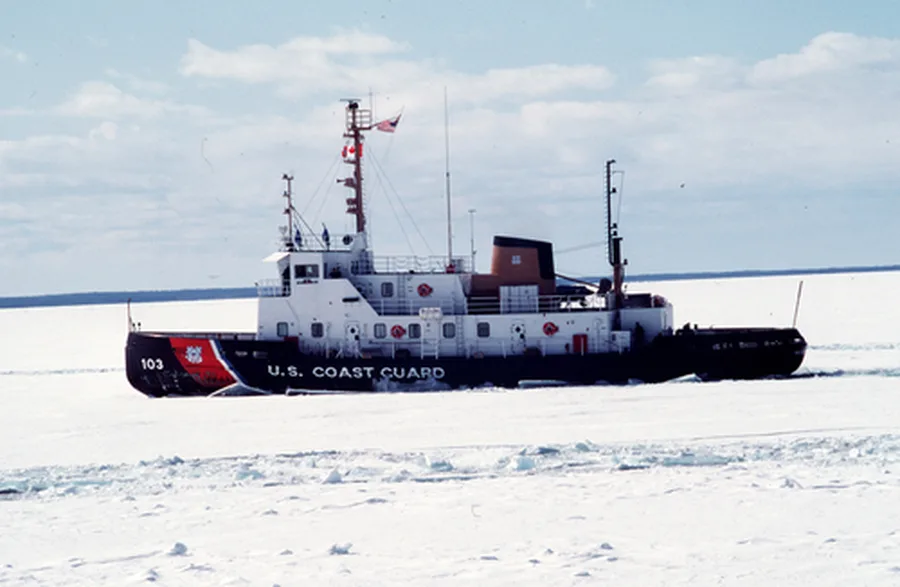
USCGC Mobile Bay (WTGB-103) is an active icebreaking tug under the direction of the United States Coast Guard. Her homeport is located in Sturgeon Bay, Wisconsin. She is one of two ships in her class that has been equipped with a 120-foot (37 m) aids-to-navigation (ATON) barge operating on the Great Lakes. The vessel was specifically designed to carry out icebreaking missions, but also carries out missions in search and rescue, environmental pollution response, maritime law enforcement, and homeland security. During the fall season, Mobile Bay is responsible for aids to navigation work in Green Bay and Lake Michigan. Mobile Bay is able to do ATON, unlike other vessels of her class, because it is one of two ships in the class with a 120-foot (37 m) ATON barge. During this time, the cutter is tasked with replacing traditional channel markers with winter markers, which are more capable of handling the extreme conditions seen in the Great Lakes during the winter months. During the winter months, Mobile Bay detaches from the ATON barge and is largely responsible for ice breaking in the Northern Great Lakes in order to maintain an operable level of maritime commerce in the region. This time period often lasts from December to Mid-April. During the spring months, Mobile Bay once again is responsible for aids to navigation work.
Compliance
On 26 May 2007, the downbound vessel Mobile Bay reported a small fire in the stack while near Lanoraie, Quebec. Fire was extingished and vessel continued voyage.
Recorded marine occurrences naming this vessel.
Composite Risk
Multiple adverse factors, or a hard ship-specific signal, lift this hull above the fleet norm.
A coverage-weighted blend of the single component we could read for this hull; the weights renormalise over only the components present, so a thin read is never inflated and a hull is never credited a “safe 0” for a signal it has no row for. This headline is flagged low-confidence (a thin or structural-only read) and should not be treated as a verdict. Higher means riskier. Derived in-house from government-open port-State-control, flag, sanctions and our own vessel data; weight it by the coverage above.
Commercial
Price it in the Route Planner between any two commercial ports: ballast and laden legs, two fuels at live bunker prices, port and canal costs, the weather on the way, and the TCE set against the market.
Fleet Management

Visual Archive