Technical Specifications
Overview
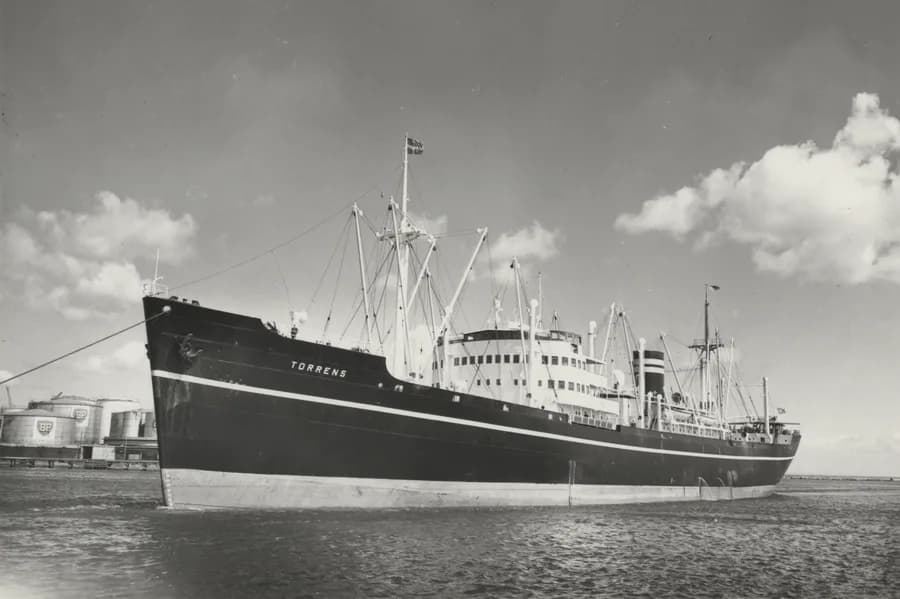
MS Torrens was a Norwegian cargo motor ship built in 1939 by Kockums Mek.Verksted AB., Malmö, Sweden, for Wilhelm Wilhelmsen, Tønsberg, Norway. In 1940, after the German invasion of Norway, the ship operated for the Norwegian Shipping and Trade Mission (Nortraship) in London. Voyages in early 1940 involved U.S. Atlantic ports and the Philippines, China and Japan. By mid 1940 the operations tended to be out of U.S. Pacific coast ports, with occasional visits to the Atlantic, to the same destinations. The same pattern repeated in 1941. With entry of the United States into the war Torrens was transferred to the U.S. War Shipping Administration (WSA) on 23 January 1942. The ship was allocated to Army requirements until 22 January 1946. The ship first operated as a cargo ship but was converted into a troop ship with a capacity for 1,702 passengers. Until June 1945 Torrens operated in the Southwest Pacific theater. After June 1945 the ship operated to Europe until January 1946 when released from troop transport service and returned to Nortraship on 22 January 1946. After return to owners the ship was eventually sold in 1966 to a firm in Piraeus, Greece and renamed Georgios M. The ship was sold to Chinese breakers in 1970 and scrapped in April of that year.
Composite Risk
Multiple adverse factors, or a hard ship-specific signal, lift this hull above the fleet norm.
A coverage-weighted blend of the single component we could read for this hull; the weights renormalise over only the components present, so a thin read is never inflated and a hull is never credited a “safe 0” for a signal it has no row for. This headline is flagged low-confidence (a thin or structural-only read) and should not be treated as a verdict. Higher means riskier. Derived in-house from government-open port-State-control, flag, sanctions and our own vessel data; weight it by the coverage above.
Commercial
Price it in the Route Planner between any two commercial ports: ballast and laden legs, two fuels at live bunker prices, port and canal costs, the weather on the way, and the TCE set against the market.

Visual Archive