Technical Specifications
Overview
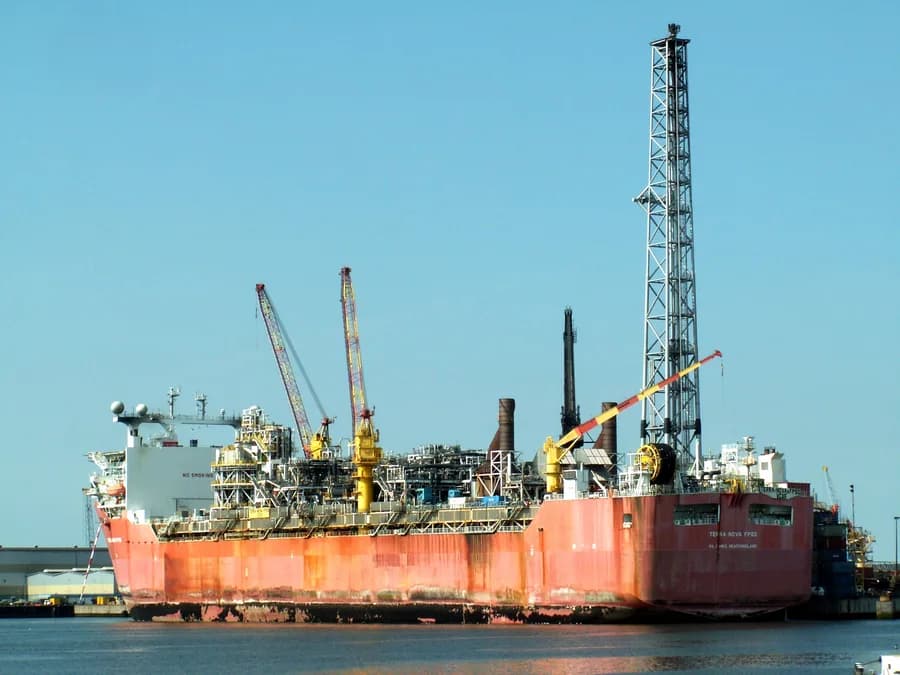
Terra Nova is a Floating Production Storage and Offloading Vessel (FPSO) for servicing the Terra Nova oil and gas field. Since 2019 the vessel has been off-field undergoing a life extension programme, initially at Bull Arm Fabrication Site, then Navantia, Ferrol. In February 2023, the vessel returned to Canada, as of 12th April is undergoing recommissioning at Bull Arm. The Terra Nova field is operated by Suncor Energy Inc., with a 37.675% interest, located approximately 350 kilometres (220 mi) east off the coast of Newfoundland, Canada in the North Atlantic Ocean. The Terra Nova field is south of the successful Hibernia field and the more recent White Rose field. All three fields are in the Jeanne d'Arc Basin on the eastern edge of the famous Grand Banks fishing territory. Terra Nova lost 165 m³ of oil into the ocean in 2004 because of two mechanical failures. In June 2006, production on Terra Nova was halted as the platform was sent to Rotterdam for a refit. She returned to the Terra Nova field on 25 September 2006.
Compliance
On 18 May 2026, the supply boat "SKANDI CLIPPER", with 13 people on board, reported a fire in its port funnel during cargo operations alongside the floating production storage and offloading unit "TERRA NOVA FPSO", 185 nautical miles SE of St. John's, NL. The vessel proceeded away from the site and the crew extinguished the fire before assessing minor damage.
Recorded marine occurrences naming this vessel.
Composite Risk
Multiple adverse factors, or a hard ship-specific signal, lift this hull above the fleet norm.
A coverage-weighted blend of the single component we could read for this hull; the weights renormalise over only the components present, so a thin read is never inflated and a hull is never credited a “safe 0” for a signal it has no row for. This headline is flagged low-confidence (a thin or structural-only read) and should not be treated as a verdict. Higher means riskier. Derived in-house from government-open port-State-control, flag, sanctions and our own vessel data; weight it by the coverage above.
Commercial
Price it in the Route Planner between any two commercial ports: ballast and laden legs, two fuels at live bunker prices, port and canal costs, the weather on the way, and the TCE set against the market.

Visual Archive