Technical Specifications
Overview
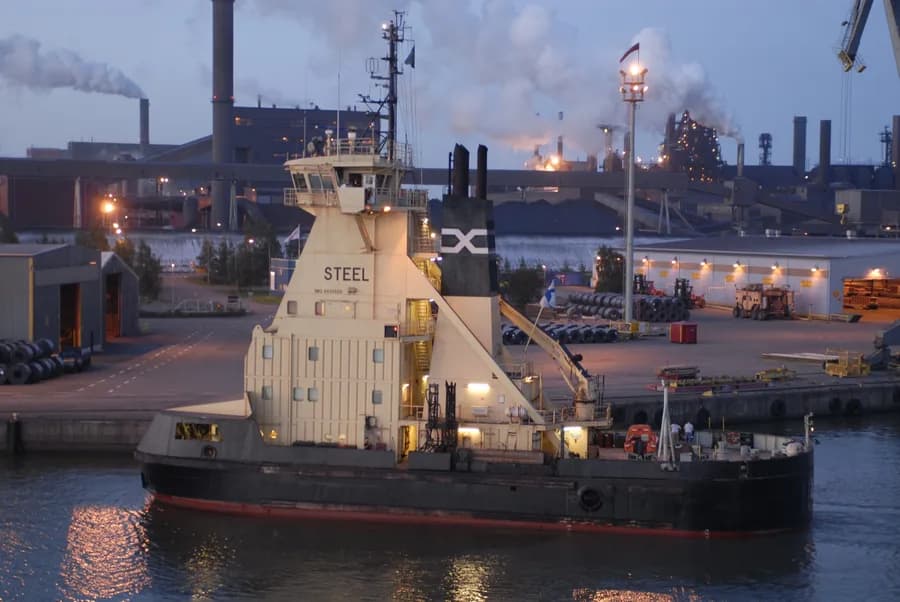
Steel is a Finnish pusher vessel owned and operated by ESL Shipping. It is part of the Finnpusku integrated tug and barge system developed in the 1980s by Finnlines, a Finnish shipping company that also managed the vessel until 2003, in co-operation with Rautaruukki for the transportation needs of the steel company. The vessel, built by Hollming in Rauma, Finland, as Finn, was delivered on 28 April 1987 and has since been used mainly to supply raw materials to the Raahe Steel Works. On 27 December 1990 the vessel capsized along with the barge Baltic outside Hanko, Finland, while en route from Raahe to Koverhar in southern Finland with a cargo of iron ore concentrate. The cargo shifted in heavy weather, resulting in the loss of stability and the vessel capsizing in 10–15 seconds. Seven crew members and a pilot lost their lives in the accident, but the chief engineer and chief officer survived in an air pocket in the aftmost part of the engine room and were later rescued through a hole cut in the bottom. The combination was later rightened and towed to Rauma for rebuilding. Finn returned to service as Steel and Baltic as Botnia in 1991. Steel has an identical sister vessel, Rautaruukki, which was delivered in 1986.
Live Tracking
Most time stopped at Lulea — 4 d across 13 stays.
Derived from the AIS track — runs of near-zero speed (anchored, moored or drifting) snapped to the nearest port. Builds up as we observe the vessel.
Intelligence
Verified reported figure. Band is peer-relative, not official IMO CII.
AIS-derived from our live feed.
Operational Status
Stopped, anchored or moored on its latest broadcast — parked, not necessarily withdrawn.
Read from the single most-recent AIS broadcast we hold for this hull — we keep no position history, so this is a point-in-time posture, not a dwell inference. Derived in-house from our own AIS feed; weight it by the broadcast age above.
Arrivals, time in port and the load/discharge inferred from the draught change — detected from AIS track history. An open call means the vessel is still in port (no departure observed yet).
Method: each call is a run of fixes inside a port’s geofence confirmed by a stop (or an AIS gap); load/discharge is the sign of the draught delta over the call. Indicative — arrivals before our AIS history began read from the first observation.
Time-in-port summed by port from the AIS-detected port-call history — the ports this vessel has spent the most time at, longest first.
Based on 9 completed calls observed since — open calls (no departure yet) are excluded. The distribution sharpens as AIS history accrues.
Composite Risk
Multiple adverse factors, or a hard ship-specific signal, lift this hull above the fleet norm.
A coverage-weighted blend of the 2 components we could read for this hull — the weights renormalise over only the components present, so a thin read is never inflated and a hull is never credited a “safe 0” for a signal it has no row for. This headline is flagged low-confidence (a thin or structural-only read) and should not be treated as a verdict. Higher means riskier. Derived in-house from government-open port-State-control, flag, sanctions and our own vessel data; weight it by the coverage above.

Visual Archive
Explore More