Technical Specifications
Overview
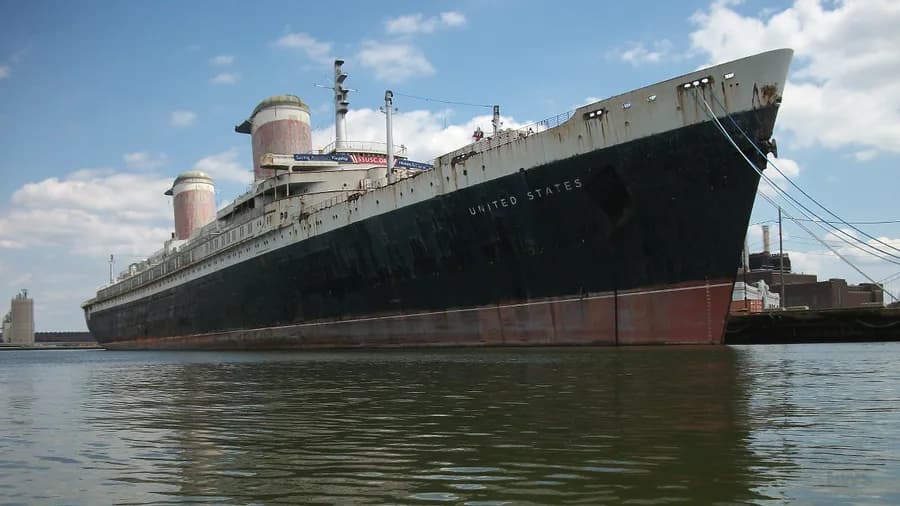
SS United States is a retired American ocean liner that was built during 1950 and 1951 for United States Lines. She is the largest ocean liner to be entirely constructed in the United States and the fastest ocean liner to cross the Atlantic Ocean in either direction, earning the Blue Riband for the highest average speed since her maiden voyage in 1952, a title that remains uncontested. The ship was designed by American naval architect William Francis Gibbs and could have been converted into a troopship if required by the United States Navy in time of war. The ship served as a US icon, transporting celebrities and immigrants throughout her career between 1952 and 1969. Her design included innovations in steam propulsion, hull form, fire safety, and damage control. Despite her record speed, passenger counts declined in the mid-1960s due to the rise in jet-propelled trans-Atlantic flights. Following the financial collapse of United States Lines, United States was withdrawn from service in a surprise announcement in 1969. All planned cruises were canceled, and the ship changed owners repeatedly for the next several decades. Every owner attempted to make the ship profitable, but she was aging and poorly maintained. In 1984, her interior furnishings were sold at auction, and the rest of her interiors were stripped to the bulkheads in 1994.
Composite Risk
Multiple adverse factors, or a hard ship-specific signal, lift this hull above the fleet norm.
A coverage-weighted blend of the single component we could read for this hull; the weights renormalise over only the components present, so a thin read is never inflated and a hull is never credited a “safe 0” for a signal it has no row for. This headline is flagged low-confidence (a thin or structural-only read) and should not be treated as a verdict. Higher means riskier. Derived in-house from government-open port-State-control, flag, sanctions and our own vessel data; weight it by the coverage above.
Commercial
Price it in the Route Planner between any two commercial ports: ballast and laden legs, two fuels at live bunker prices, port and canal costs, the weather on the way, and the TCE set against the market.
Fleet Management

Visual Archive