Technical Specifications
Overview
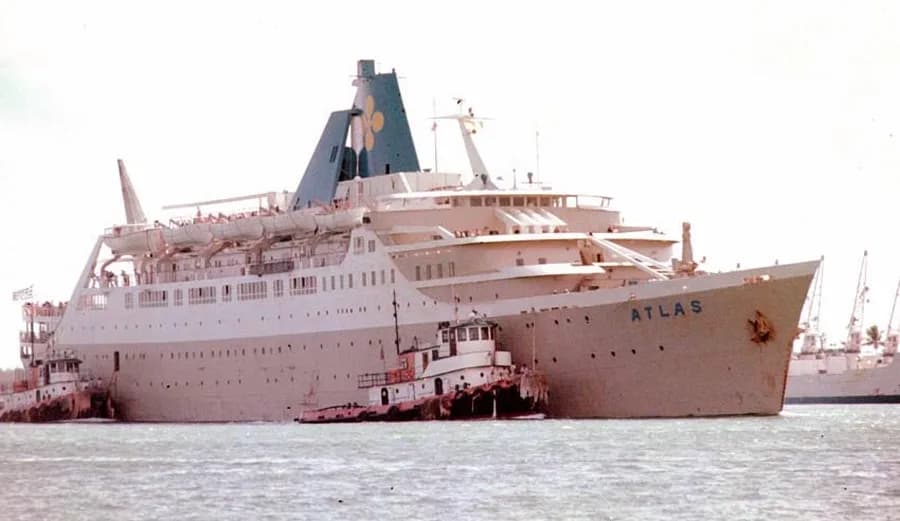
SS Ryndam was an ocean liner built for Holland America Line in 1951. She was built by N.V. Dok en Werfmaatschappij Wilton-Fijenoord, Schiedam. She was christened by Mrs. C. Tjarda van Stakenborgh Stachouwer-Marburg (wife of the prewar Governor-General of the Dutch East Indies). The original intent of her design was to be designated as the freighter Dinteldyk (which was also designed to carry a small complement of passengers). A decision was made to have her redesigned as a liner in 1950, but she still retained the stout hull lines and sturdy machinery of a freighter. The ship played a major role in post-war immigration from Europe making frequent voyages to New York City and the Pier 21 immigration facility in Halifax, Nova Scotia, Canada. In March 1962 Edward & Alex Van Halen, and their parents Jan & Eugenia Van Halen, immigrated to the US aboard the SS Ryndam. For many years it was also the shipboard campus of the World Campus Afloat, which sailed the world offering college courses for students from all over the world. In 1973, she was sold to a Panamanian subsidiary of a Greek shipping interest and extensively refitted with her bow line changed, many internal changes, and alterations to her superstructure. This was done to give her a more modern (at the time) 1970s design appearance.
Composite Risk
Multiple adverse factors, or a hard ship-specific signal, lift this hull above the fleet norm.
A coverage-weighted blend of the single component we could read for this hull; the weights renormalise over only the components present, so a thin read is never inflated and a hull is never credited a “safe 0” for a signal it has no row for. This headline is flagged low-confidence (a thin or structural-only read) and should not be treated as a verdict. Higher means riskier. Derived in-house from government-open port-State-control, flag, sanctions and our own vessel data; weight it by the coverage above.
Commercial
Price it in the Route Planner between any two commercial ports: ballast and laden legs, two fuels at live bunker prices, port and canal costs, the weather on the way, and the TCE set against the market.
Fleet Management

Visual Archive