Technical Specifications
Overview
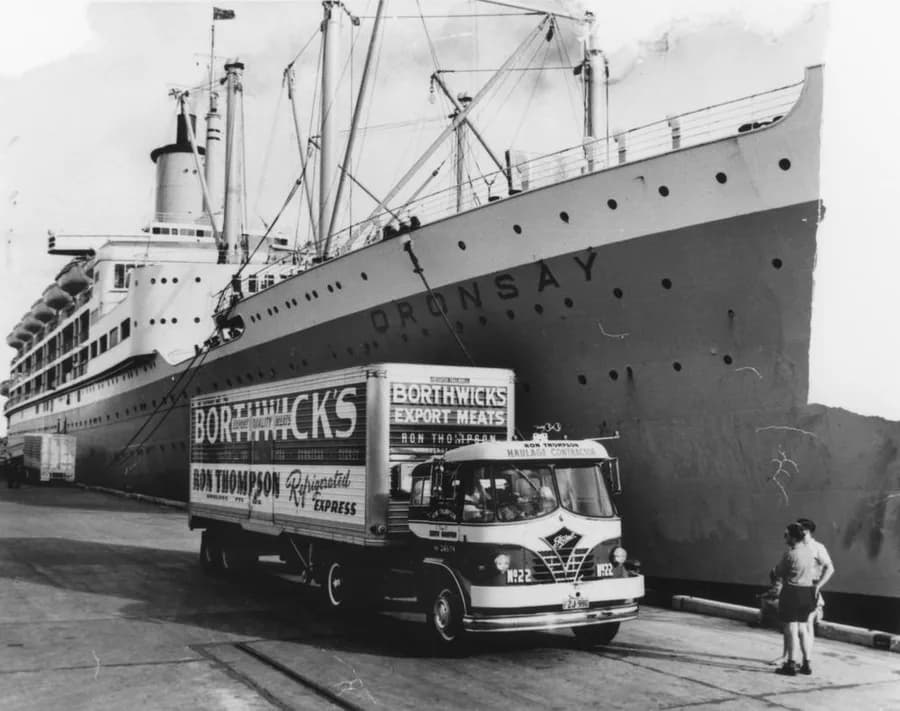
SS Oronsay was the second Orient Line ship built after World War II. A sister ship to Orcades, she was named after the island of Oronsay off the west coast of Scotland. The liner was completed in 1951 at Vickers-Armstrong, Barrow-in-Furness, but was delivered several months behind schedule because of a serious fire that broke out in the fitting-out berth. The Oronsay operated the UK to Australasia service, via the Suez Canal. Her accommodation set new standards, in both first and tourist class, with decor by Brian O'Rourke. On 1 January 1954, Oronsay left Sydney on the first Orient Line transpacific voyage to Auckland, Suva, Honolulu, Victoria, Vancouver and San Francisco, returning via the same ports. In later years the transpacific sailings became a regular feature of the Orient/P&O services. In 1960 the Orient Line and P&O fleets were merged under the control of P&O-Orient Lines (Passenger Services) Ltd. Oronsay continued to operate under the Orient houseflag and retained her corn-coloured hull until 1964, when her hull was painted P&O white. In 1966, P&O having acquired the balance of the Orient shares (it had controlled Orient since 1919), Orient Line was wound up and Oronsay, along with her fleet mates, was transferred to the ownership of P&O and hoisted the P&O houseflag.
Composite Risk
Multiple adverse factors, or a hard ship-specific signal, lift this hull above the fleet norm.
A coverage-weighted blend of the single component we could read for this hull; the weights renormalise over only the components present, so a thin read is never inflated and a hull is never credited a “safe 0” for a signal it has no row for. This headline is flagged low-confidence (a thin or structural-only read) and should not be treated as a verdict. Higher means riskier. Derived in-house from government-open port-State-control, flag, sanctions and our own vessel data; weight it by the coverage above.
Commercial
Price it in the Route Planner between any two commercial ports: ballast and laden legs, two fuels at live bunker prices, port and canal costs, the weather on the way, and the TCE set against the market.
Fleet Management

Visual Archive