Technical Specifications
Overview
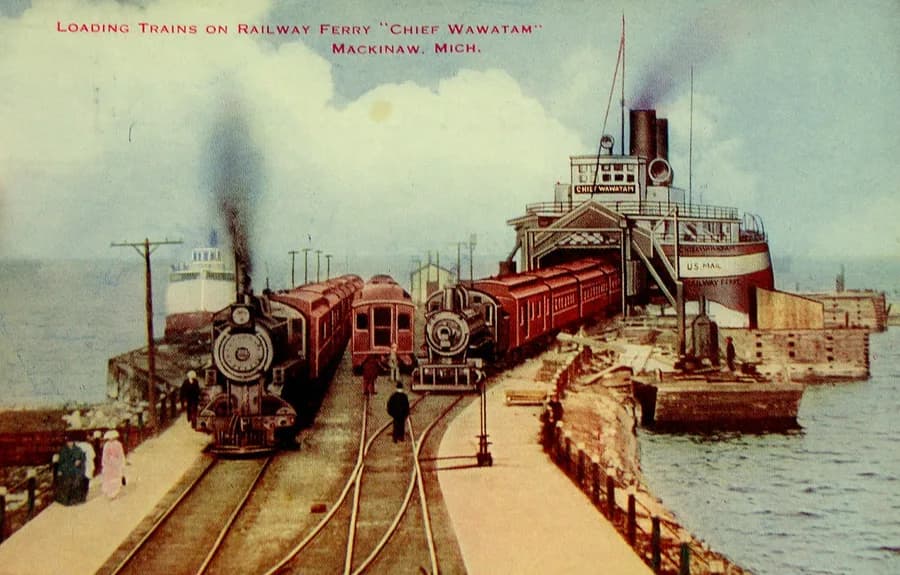
Chief Wawatam (nicknamed the Chief) was a coal-fired steel ship in operation on the Great Lakes from 1911 to 1984. It was cut down into a barge by new owners in 1989, and scrapped in 2009. For most of its working life, the vessel was based in St. Ignace, Michigan. It was named after a distinguished Ojibwa chief of the 1760s. In initial revenue service, the Chief Wawatam served as a train ferry, passenger ferry and icebreaker that operated year-round at the Straits of Mackinac between St. Ignace and Mackinaw City, Michigan. During the winter months, it sometimes took many hours to cross the five-mile-wide Straits, and Chief Wawatam was fitted with complete passenger hospitality spaces. Chief Wawatam's work began to change in the 1940s. Its role as an icebreaker stationed in the upper Great Lakes was supplanted in 1944 by USCGC Mackinaw, a U.S. Coast Guard icebreaker. The ship's passenger traffic dropped off in the years following World War II. The remaining passenger service ended with the completion of the Mackinac Bridge in 1957 that connected the Upper and Lower peninsulas of the U.S. state of Michigan. Chief Wawatam was then used exclusively as a railroad ferry shuttling freight cars across the Straits. It was taken out of service in 1985, and a 1989 sold to Purvis Marine, Ltd., of Sault Ste. Marie Ontario. The two railroad docks that were used in Mackinaw City and in St.
Composite Risk
Multiple adverse factors, or a hard ship-specific signal, lift this hull above the fleet norm.
A coverage-weighted blend of the single component we could read for this hull; the weights renormalise over only the components present, so a thin read is never inflated and a hull is never credited a “safe 0” for a signal it has no row for. This headline is flagged low-confidence (a thin or structural-only read) and should not be treated as a verdict. Higher means riskier. Derived in-house from government-open port-State-control, flag, sanctions and our own vessel data; weight it by the coverage above.
Commercial
Price it in the Route Planner between any two commercial ports: ballast and laden legs, two fuels at live bunker prices, port and canal costs, the weather on the way, and the TCE set against the market.

Visual Archive