Technical Specifications
Overview
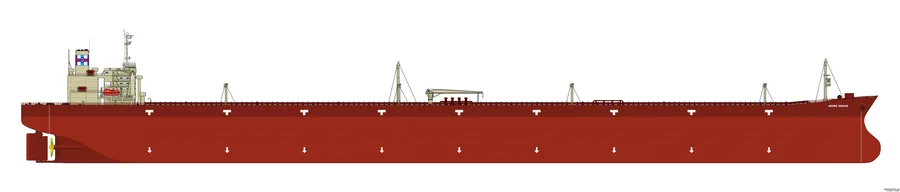
TT Seawise Giant—formerly Oppama; later Happy Giant, Jahre Viking, Knock Nevis, and Mont—was a ULCC supertanker and the longest self-propelled ship in history. It was built in 1974–1979 by Sumitomo Heavy Industries in Yokosuka, Kanagawa, Japan. Seawise Giant's engines were powered by Ljungström turbines. The ship possessed the greatest deadweight tonnage ever recorded. Fully laden, her displacement was 657,019 tonnes. At the time she was built, she was the heaviest self-propelled ship of any kind. With a laden draft of 24.6 m (81 ft) and a length of 458.45 m (1,504.1 ft), the ship was incapable of navigating the English Channel, the Suez Canal or the Panama Canal. She is generally considered the largest self-propelled ship ever built. In 2013, her overall length was surpassed by 30 m (98 ft) by the floating liquefied natural gas (FLNG) installation Shell Prelude, a monohull barge design 488 m (1,601 ft) long with 600,000 tonnes displacement.. The ship was damaged in an airstrike in 1988 during the Iran–Iraq War but later repaired and restored to service. The vessel was moored off the coast of Qatar in the Persian Gulf at the Al Shaheen Oil Field in 2004 and converted to a floating storage and offloading (FSO) unit. Seawise Giant was sold to Indian ship breakers and renamed Mont for her final journey in December 2009.
Composite Risk
Multiple adverse factors, or a hard ship-specific signal, lift this hull above the fleet norm.
A coverage-weighted blend of the single component we could read for this hull; the weights renormalise over only the components present, so a thin read is never inflated and a hull is never credited a “safe 0” for a signal it has no row for. This headline is flagged low-confidence (a thin or structural-only read) and should not be treated as a verdict. Higher means riskier. Derived in-house from government-open port-State-control, flag, sanctions and our own vessel data; weight it by the coverage above.
Commercial
Price it in the Route Planner between any two commercial ports: ballast and laden legs, two fuels at live bunker prices, port and canal costs, the weather on the way, and the TCE set against the market.

Visual Archive