Technical Specifications
Overview
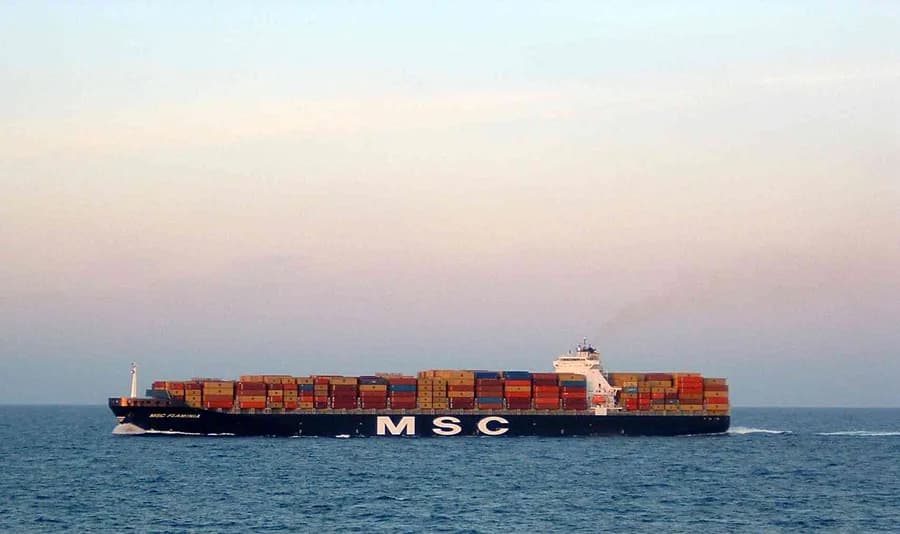
MSC Flaminia is a German container ship which caught fire on 14 July 2012, claiming three lives (only two of which could be recovered) and forcing the crew to abandon ship in the middle of the Atlantic Ocean. After the fire had been brought under control, the stricken container ship was towed to Europe and arrived at Wilhelmshaven, Germany, on 9 September 2012. In March 2013, she departed Wilhelmshaven for Mangalia, Romania for repairs which were finished in July 2014. The ship is currently sailing under the name CMA CGM San Francisco.
Live Tracking
Most time stopped at Port of Durban — 23 h across 1 stay.
Derived from the AIS track — runs of near-zero speed (anchored, moored or drifting) snapped to the nearest port. Builds up as we observe the vessel.
Intelligence
How a hull like this loses value with age (today's market). The dot marks this ship at 25 yrs.
Estimate from $/dwt of similar-size, similar-age ships sold in the last 24 months. Indicative, not a certified valuation.
Open the full multi-model valuationVerified reported figure. Band is peer-relative, not official IMO CII.
AIS-derived from our live feed.
Build Series
Sister hulls share a yard, segment, build year (±1) and deadweight (±3%) — the cleanest comparables for valuation. Derived in-house from our fleet register; coverage is limited to hulls carrying a recorded builder, so a series may be incomplete.
Operational Status
The latest broadcast is too stale or lacks the speed / status to classify.
Read from the single most-recent AIS broadcast we hold for this hull — we keep no position history, so this is a point-in-time posture, not a dwell inference. Derived in-house from our own AIS feed; weight it by the broadcast age above.
Arrivals, time in port and the load/discharge inferred from the draught change — detected from AIS track history. An open call means the vessel is still in port (no departure observed yet).
Method: each call is a run of fixes inside a port’s geofence confirmed by a stop (or an AIS gap); load/discharge is the sign of the draught delta over the call. Indicative — arrivals before our AIS history began read from the first observation.
Time-in-port summed by port from the AIS-detected port-call history — the ports this vessel has spent the most time at, longest first.
Based on 2 completed calls observed since — open calls (no departure yet) are excluded. The distribution sharpens as AIS history accrues.
Composite Risk
Strong, corroborated adverse evidence — a detention, sanctions exposure or an AIS-gap / behavioural signal.
A coverage-weighted blend of the 3 components we could read for this hull — the weights renormalise over only the components present, so a thin read is never inflated and a hull is never credited a “safe 0” for a signal it has no row for. Higher means riskier. Derived in-house from government-open port-State-control, flag, sanctions and our own vessel data; weight it by the coverage above.
Estimated
Container · summer draught 12.4 m · 106.3 t per cm immersion
Estimate only — modelled from deadweight (hull geometry) using a first-principles hydrostatic model, not measured hydrostatic tables. The design draught it is anchored to is unreliable across the fleet.
density DWT/GT=1.14 is consistent with declared container
Declared type is consistent with the class implied by the vessel’s size signals. Inferred via our shared size-based classifier.
Transparency
Behavioural flags raised against this vessel — each shown with the raw evidence behind it. Derived in-house from data we are entitled to publish; informational, not a determination of wrongdoing.
Stopped transmitting relative to the live feed front
Method: gap measured vs the live feed's own max timestamp, not wall-clock. Source: TheMaritime aisstream.io ingest (ais_positions).
Signals are a current-state view: a flag clears once the vessel stops tripping its detector. These are screening indicators, not a substitute for your own due diligence.
Commercial

Visual Archive
Explore More