Technical Specifications
Overview
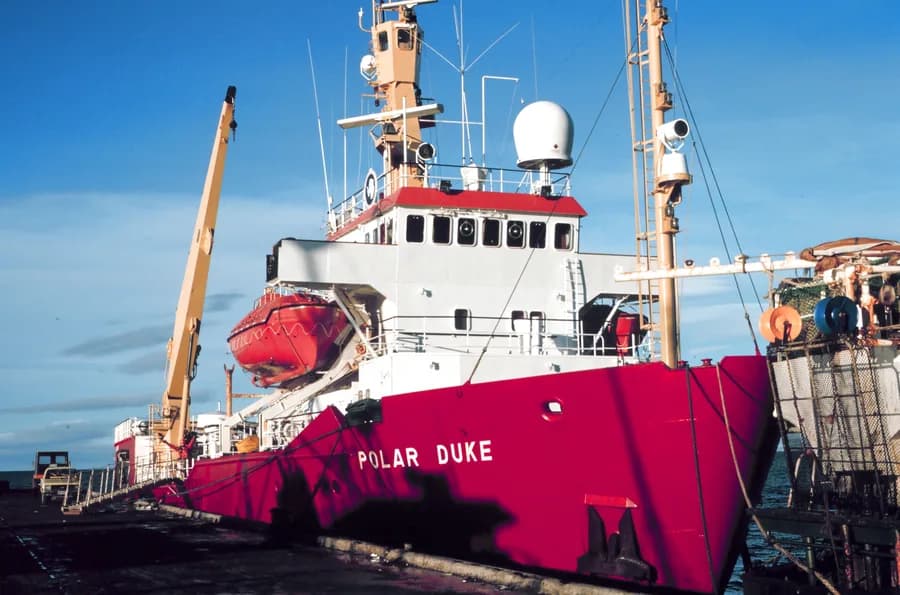
The RV Polar Duke is a 219-foot ice-strengthened research vessel built in 1983. Polar Duke was designed specifically for scientific research with wet and dry laboratories, and an electronic workshop and laboratory. The hull is constructed similar to that of an icebreaker, but the ship isn’t as powerful as an icebreaker. It was originally equipped with a stern A-frame crane and helicopter deck; these were both removed in a major refit in 1998. Polar Duke was chartered by the National Science Foundation for use in support of the United States Antarctic Program (USAP) from January 1985 until June 1997. The "Duke" transported supplies and personnel between Palmer Station, Antarctica and the port of Punta Arenas, Chile, on the Strait of Magellan, for 13 years, providing seagoing and shore-based research support in waters and islands in the Drake Passage and around the Antarctic Peninsula. In November 1997 Polar Duke was replaced in its role with USAP by the ice strengthened Lawrence M. Gould. In May 1998, the Polar Duke was rebuilt by its Norwegian owner, Rieber Shipping, as a seismic survey vessel, extending the aft superstructure and converting the helideck to a regular deck. It was assigned to a Rieber subsidiary, Exploration Vessel Resources, which was spun off in 2005 and acquired later that year by CGG, which is now part of CGGVeritas.
Compliance
While performing general maintenance on the vessel's workboat, the battery gas exploded and the second engineer received battery burns on his arm and face. Hospitalized.
Recorded marine occurrences naming this vessel.
Composite Risk
Multiple adverse factors, or a hard ship-specific signal, lift this hull above the fleet norm.
A coverage-weighted blend of the single component we could read for this hull; the weights renormalise over only the components present, so a thin read is never inflated and a hull is never credited a “safe 0” for a signal it has no row for. This headline is flagged low-confidence (a thin or structural-only read) and should not be treated as a verdict. Higher means riskier. Derived in-house from government-open port-State-control, flag, sanctions and our own vessel data; weight it by the coverage above.
Commercial
Price it in the Route Planner between any two commercial ports: ballast and laden legs, two fuels at live bunker prices, port and canal costs, the weather on the way, and the TCE set against the market.
Fleet Management

Visual Archive