Technical Specifications
Overview
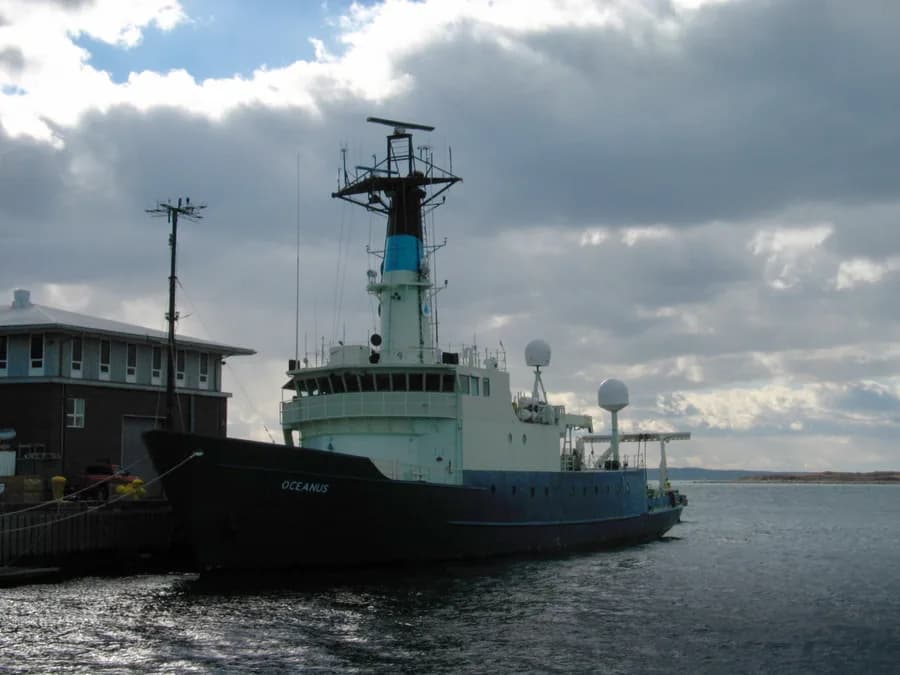
RV Oceanus is a Regional-class research vessel owned by the National Science Foundation, based in Newport, Oregon, and maintained and operated by Oregon State University. The ship was originally delivered to the Woods Hole Oceanographic Institution (WHOI) for operation as a part of the U.S. Academic Research Fleet as a University-National Oceanographic Laboratory System (UNOLS) designated operator. in November 1975. Oceanus made the first operational cruise in April 1976 and operated under WHOI for thirty-six years in the Atlantic Ocean with some operations in the Mediterranean and Caribbean seas. The ship was scheduled to be retired in November 2011 but instead was transferred to Oregon State University, College of Earth, Ocean, and Atmospheric Sciences, for operation, replacing sister ship, RV Wecoma. On January 25, 2012 the ship began transit to Newport, Oregon and the Hatfield Marine Science Center for operation by Oregon State University. Oceanus arrived in Newport, Oregon on February 21, 2012 ahead of the March retirement of sister ship Wecoma. Oceanus was an interim replacement during the period while NSF began the design and construction of three new Regional-class research vessels, the first of which is expected to be launched in 2023 and to be operated by OSU under the name RCRV Taani for NSF.
Composite Risk
Multiple adverse factors, or a hard ship-specific signal, lift this hull above the fleet norm.
A coverage-weighted blend of the single component we could read for this hull; the weights renormalise over only the components present, so a thin read is never inflated and a hull is never credited a “safe 0” for a signal it has no row for. This headline is flagged low-confidence (a thin or structural-only read) and should not be treated as a verdict. Higher means riskier. Derived in-house from government-open port-State-control, flag, sanctions and our own vessel data; weight it by the coverage above.
Commercial
Price it in the Route Planner between any two commercial ports: ballast and laden legs, two fuels at live bunker prices, port and canal costs, the weather on the way, and the TCE set against the market.
Fleet Management

Visual Archive