Technical Specifications
Overview
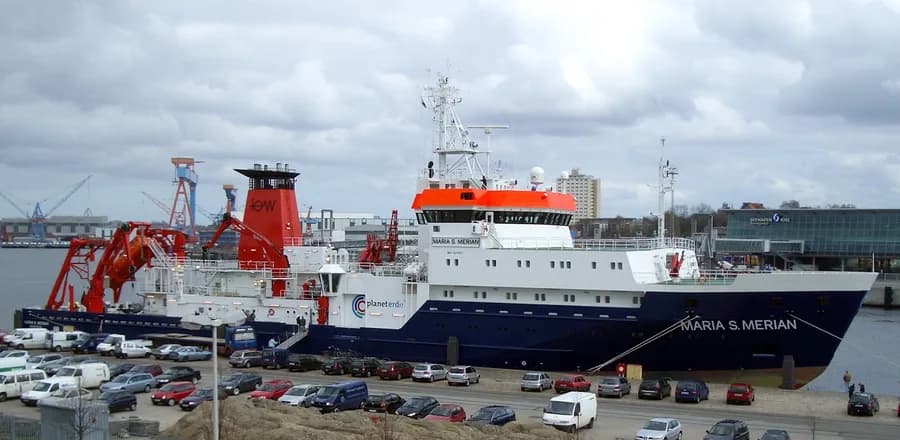
RV Maria S. Merian is Germany's second most modern research vessel, named after the naturalist and illustrator Maria Sybilla Merian. As of March 2006, Germany operates three other research vessels of its class, none of which is as well-equipped. The Merian was financed by the German government and is assigned to the Leibniz Institute for Baltic Sea Research at Warnemünde, with Rostock as its home port. It is also available to several other German research institutes. Its tasks are Arctic research, research on the Gulf Stream, and seabed research to a depth of 10 km. It is crewed by a complement of 21, and can additionally accommodate 22 scientists. The vessel is equipped with several laboratories. It has room for 150 tonnes of additional scientific equipment in accessible containers, providing flexibility in research assignments. The ship is equipped with two azimuth thrusters, a lateral pump-jet, and satellite navigation, enabling it to automatically maintain an exact position. It can operate without any polluting emissions for 48 hours (apart from the normal engine exhaust), allowing it to conduct research in ecologically sensitive areas. The Merian is capable of operating in near-polar regions and can handle drift ice up to a thickness of 80 cm. It is 94.80 m long, 19.20 m wide, and has a maximum draft of 6.50 m.
Compliance
On 31 August 2023, the research vessel "MARIA S. MERIAN" reported one of its crew members being physically incapacitated and needing medical attention in Hudson Bay, NU. The vessel proceeded to Churchill, MB where the crew member was evacuated.
Recorded marine occurrences naming this vessel.
Composite Risk
Multiple adverse factors, or a hard ship-specific signal, lift this hull above the fleet norm.
A coverage-weighted blend of the single component we could read for this hull; the weights renormalise over only the components present, so a thin read is never inflated and a hull is never credited a “safe 0” for a signal it has no row for. This headline is flagged low-confidence (a thin or structural-only read) and should not be treated as a verdict. Higher means riskier. Derived in-house from government-open port-State-control, flag, sanctions and our own vessel data; weight it by the coverage above.
Commercial
Price it in the Route Planner between any two commercial ports: ballast and laden legs, two fuels at live bunker prices, port and canal costs, the weather on the way, and the TCE set against the market.

Visual Archive