Technical Specifications
Overview
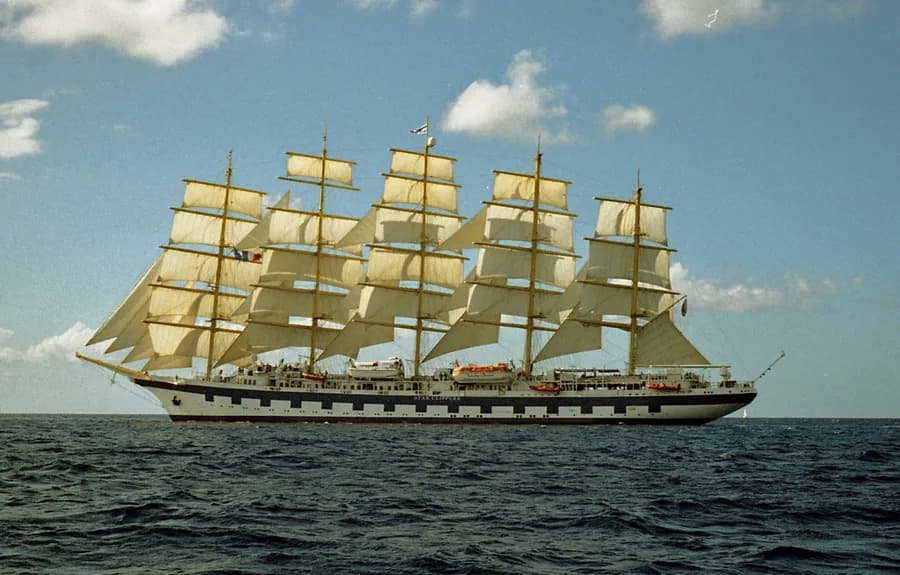
Royal Clipper is a steel-hulled five-masted fully rigged tall ship used as a cruise ship. She was redesigned by Robert McFarlane of McFarlane ShipDesign, for Star Clippers Ltd. of Sweden, the same designer behind the cruise company's first two vessels Star Clipper and Star Flyer. This third one was built using an existing steel hull designed by Zygmunt Choreń that was modified by the Gdańsk Shipyard, where 24 metres (79 ft) was added to its length. Originally built by Polish communist authorities as "Gwarek" she was intended as a floating vacation home for miners . This hull was sold because of financial problems. The Merwede shipyard completed the ship's interior in July 2000, whilst visiting the Pool of London, for its pre-launch to the travel industry. The renovations included frescography murals by Rainer Maria Latzke completing the ship's Mediterranean interior. Her design was based on Preussen, a famous German five-mast Flying P-Liner windjammer built in 1902. Star Clippers claims that she is the largest "true sailing ship" built since Preussen. She is listed in Guinness World Records as the largest square-rigged ship in service, with 5,202 square metres (55,990 sq ft) of sail. Her sails can be handled with a crew as small as twenty using powered controls. Royal Clipper cruises the Mediterranean during the summer.
Composite Risk
Multiple adverse factors, or a hard ship-specific signal, lift this hull above the fleet norm.
A coverage-weighted blend of the single component we could read for this hull; the weights renormalise over only the components present, so a thin read is never inflated and a hull is never credited a “safe 0” for a signal it has no row for. This headline is flagged low-confidence (a thin or structural-only read) and should not be treated as a verdict. Higher means riskier. Derived in-house from government-open port-State-control, flag, sanctions and our own vessel data; weight it by the coverage above.
Commercial
Price it in the Route Planner between any two commercial ports: ballast and laden legs, two fuels at live bunker prices, port and canal costs, the weather on the way, and the TCE set against the market.

Visual Archive