Technical Specifications
Overview
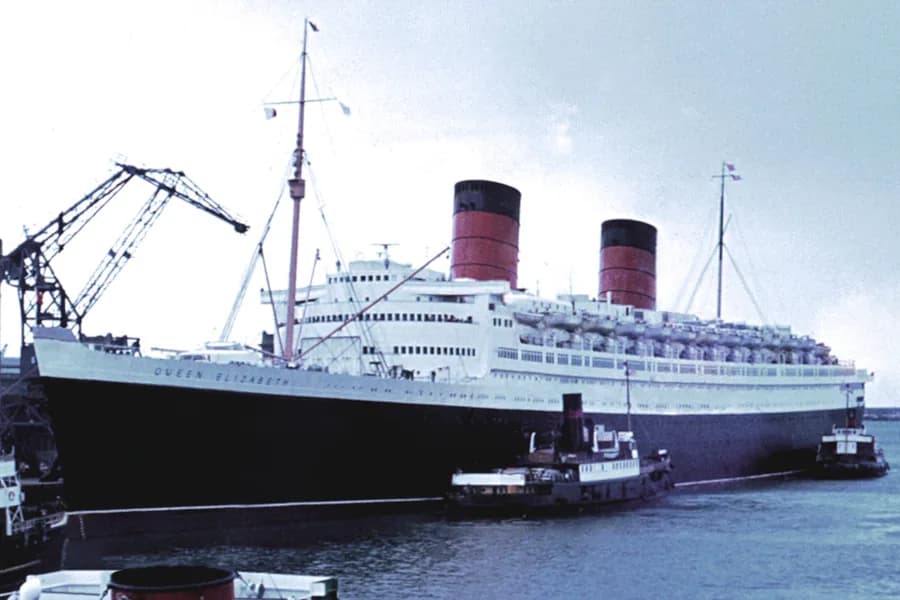
RMS Queen Elizabeth was a British ocean liner operated by the Cunard Line. Along with her sister Queen Mary, she provided a weekly transatlantic service between Southampton in the United Kingdom and New York City in the United States, via Cherbourg in France. Built by John Brown and Company at Clydebank, Scotland, as Hull 552, she was launched on 27 September 1938 and named in honour of Queen Elizabeth, the wife of King George VI. Her design was an improvement of that of Queen Mary, resulting in a vessel 12 feet (3.7 m) longer and several thousand tons greater GRT, making her the largest passenger liner ever built for a record 56 years. She entered service in March 1940 as a troopship in the Second World War, and did not make her first commercial voyage as an ocean liner until October 1946. With the decline in popularity of the transatlantic route, both ships were replaced by the smaller, more economical Queen Elizabeth 2, which made her maiden voyage in 1969. Queen Mary was retired from service on 9 December 1967, and sold to the city of Long Beach, California. Queen Elizabeth was retired after her final crossing to New York, on 8 December 1968. She was moved to Port Everglades, Florida, and converted to a tourist attraction, which opened in February 1969. The business was unsuccessful, and closed in August 1970.
Composite Risk
Multiple adverse factors, or a hard ship-specific signal, lift this hull above the fleet norm.
A coverage-weighted blend of the single component we could read for this hull; the weights renormalise over only the components present, so a thin read is never inflated and a hull is never credited a “safe 0” for a signal it has no row for. This headline is flagged low-confidence (a thin or structural-only read) and should not be treated as a verdict. Higher means riskier. Derived in-house from government-open port-State-control, flag, sanctions and our own vessel data; weight it by the coverage above.
Commercial
Price it in the Route Planner between any two commercial ports: ballast and laden legs, two fuels at live bunker prices, port and canal costs, the weather on the way, and the TCE set against the market.
Fleet Management

Visual Archive