Built by Hakodate Dock in 1995
Technical Specifications
Overview
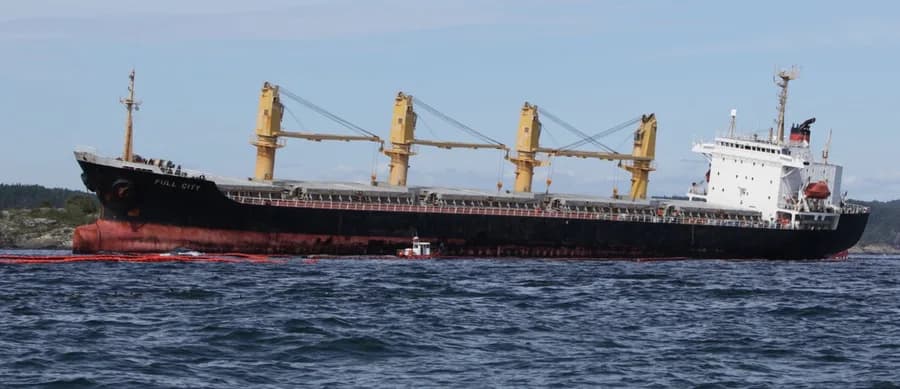
Full City is a Panama-flagged bulk carrier made infamous by running aground after an engine failure during a storm at the island of Saastein (Såstein) outside Langesund, Telemark, Norway, spilling 700 tons of heavy bunker fuel oil in a sensitive wildlife refuge area on 31 July 2009. Full City was built by Hakodate Dockyard Co. Ltd. in Hakodate, Hokkaidō, Japan in 1995. The vessel was pulled off the rocks and first towed to Stathelle, and later to Gothenburg for full drydock repairs. On 5 May 2011, as part of NATO's counter-piracy Operation Ocean Shield, the carrier USS Carl Vinson, the cruiser USS Bunker Hill, and the Turkish frigate Giresun responded to a distress call from Full City. An Indian Navy Tu-142 maritime patrol aircraft located Full City, and while Giresun boarded the merchant vessel, Bunker Hill intercepted a dhow believed to be the 'mothership' for the pirate attack. Bunker Hill's VBSS boarding party seized weapons and other equipment commonly used in piracy, and the boarding party also sank a small skiff being towed by the dhow. Giresun's boarding party found Full City's Chinese crew safe and in control of their ship.
Intelligence
Bulker value vs. age (typical size & today's market).
A quick estimate: the median $/dwt of 6 similar-size, similar-age ships sold in the last 24 months, not re-timed to today's market. The full valuation blends several models over recent sales adjusted for size, age and market moves, so its consensus value can differ from this figure. Indicative, not a certified valuation.
See the full valuation consensusThis ship has no verified emissions report. We estimate a band E from its segment, size and age (82% confidence).
Estimate, not a reported figure. Within one band 94% of the time on reported peers.
Build Series
Sister hulls share a yard, segment, build year (±1) and deadweight (±3%): the cleanest comparables for valuation. Derived in-house from our fleet register; coverage is limited to hulls carrying a recorded builder, so a series may be incomplete.
Composite Risk
Multiple adverse factors, or a hard ship-specific signal, lift this hull above the fleet norm.
A coverage-weighted blend of the 2 components we could read for this hull; the weights renormalise over only the components present, so a thin read is never inflated and a hull is never credited a “safe 0” for a signal it has no row for. This headline is flagged low-confidence (a thin or structural-only read) and should not be treated as a verdict. Higher means riskier. Derived in-house from government-open port-State-control, flag, sanctions and our own vessel data; weight it by the coverage above.
Estimated
Bulker · summer draught 9.6 m · 35.6 t per cm immersion
Estimate only: modelled from deadweight (hull geometry) using a first-principles hydrostatic model, not measured hydrostatic tables. The design draught it is anchored to is unreliable across the fleet.
density DWT/GT=1.69 is consistent with declared bulker
Declared type is consistent with the class implied by the vessel’s size signals. Inferred via our shared size-based classifier.
Commercial
Price it in the Route Planner between any two commercial ports: ballast and laden legs, two fuels at live bunker prices, port and canal costs, the weather on the way, and the TCE set against the market.
Typical Handysize speed and burn. Replace them with the ship's own figures in the planner.

Visual Archive
Explore More