Technical Specifications
Overview
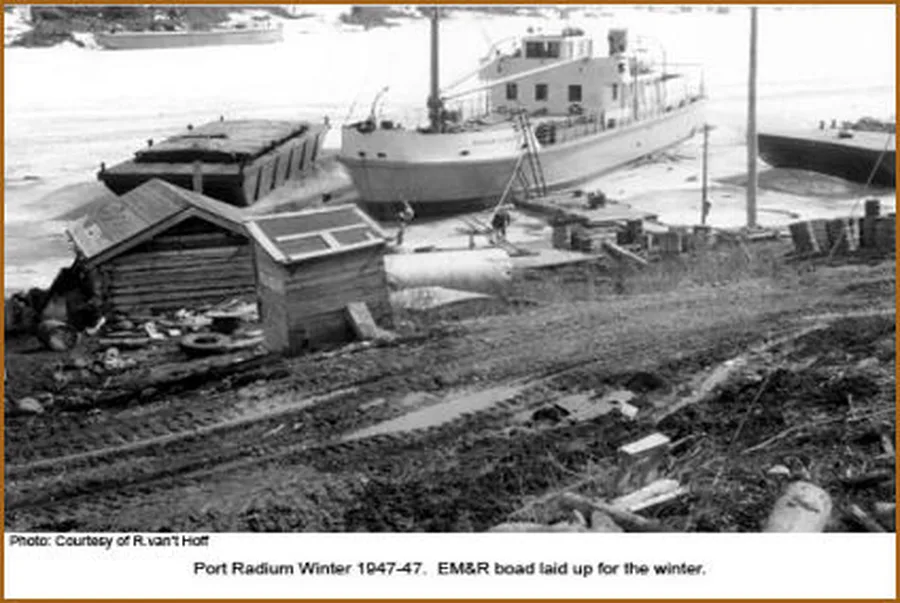
The Radium Gilbert was a tugboat built for transporting supplies to, and ore from, the radium and uranium mines in Canada's Northwest Territories. Like the other tugs in the Radium Line she was steel-hulled. She was named after Gilbert Labine, the prospector who discovered radioactive ore where Port Radium was built. She was built in Vancouver, in 1946 disassembled, so she could be shipped by rail to Waterways, Alberta. Like all vessels assembled in Waterways that operated on the Mackenzie River, and its tributaries, after she was reassembled she first proceeded downstream to Lake Athabasca, and down the Slave River, to the portage at Fort Smith. Large tractors towed even large cargo overland around large rapids there. The Radium Gilbert spent her operational life 1946 to 1980 on Great Bear Lake. She ran aground near Deline, the small community at the outlet for Great Bear Lake. Her wreck remained radioactive decades after she was used to ship radioactive ore. She was dismantled, and removed, in 2003, after lying grounded, for decades. By that time the population of Deline understood the toxic legacy of the trade in radioactive ore, and the nearby wreck was a painful reminder. In 2005 Atomic Energy of Canada published a study of the toxic legacy of the mining of radioactive ore at Port Radium.
Composite Risk
Multiple adverse factors, or a hard ship-specific signal, lift this hull above the fleet norm.
A coverage-weighted blend of the single component we could read for this hull; the weights renormalise over only the components present, so a thin read is never inflated and a hull is never credited a “safe 0” for a signal it has no row for. This headline is flagged low-confidence (a thin or structural-only read) and should not be treated as a verdict. Higher means riskier. Derived in-house from government-open port-State-control, flag, sanctions and our own vessel data; weight it by the coverage above.
Commercial
Price it in the Route Planner between any two commercial ports: ballast and laden legs, two fuels at live bunker prices, port and canal costs, the weather on the way, and the TCE set against the market.

Visual Archive