Technical Specifications
Overview
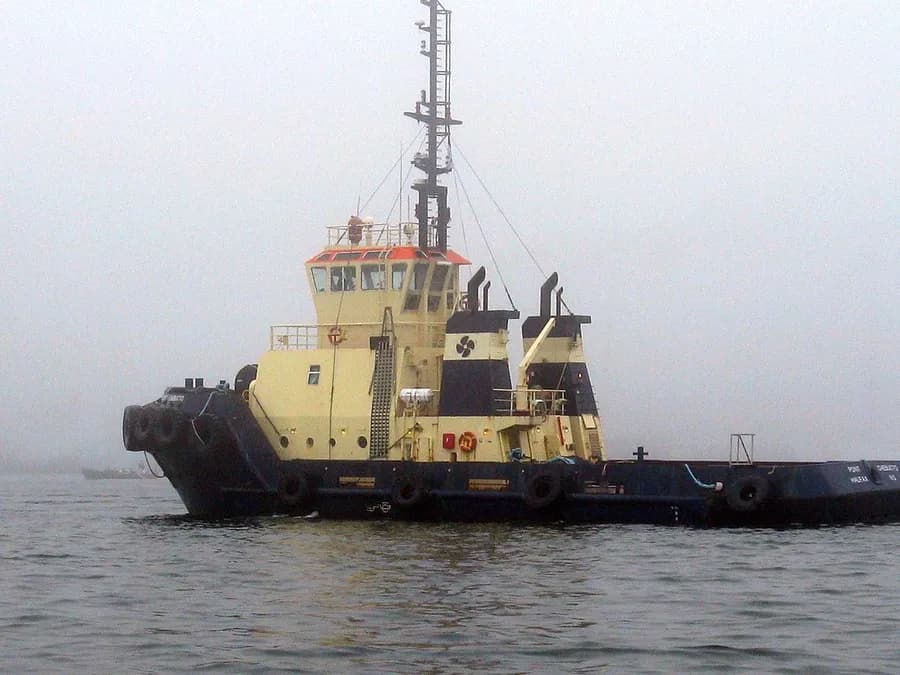
Point Chebucto is a harbour tug that was built at the Halifax Shipyard in Halifax, Nova Scotia, Canada in 1992. She was christened in January of 1993 by Mrs. Joyce Watson, wife of Cpt. David A. Watson. She is one of very few harbour tugs that were built at the Halifax Shipyards. She has been aiding ships in and out of Halifax Harbour and later Port Hawkesbury, Nova Scotia since she was registered in January 1993. The tug was built for Eastern Canada Towing Limited, a company that has been around for over 60 years. The tug is named after the point at Chebucto Head, continuing the tradition of Eastern Canada Towing of naming its tugs after points. Eastern Canada Towing took over Foundation Maritime's work in the field of Harbour, Coastal and Deep-Sea tow and salvage. The firm owns and operate a fleet of modern tugs ranging from 1250 HP - 5400 HP. Most tugs are ice strengthened, with several having Ice Class 1 certification. Their head office is also in Halifax. Eastern Canada Towing was purchased in 2007 by Svitzer, a tug boat division of Maersk. Point Chebucto is powered by twin diesel engines which put out 4000 HP and is an azimuthing stern drive tug. Her tonnage is 434 gt and she is 33.31 meters long. Her breadth is 10 meters, she sits 4.24 meters in the water and has a max speed of 12 knots.
Compliance
On 23 November 2012, the tug "POINT CHEBUCTO" reported a coast guard vessel wake caused damage to tug, gangway and tug barge while moored in Point Tupper, N.S.
On 18 June 2012, the tug "POINT CHEBUCTO" struck and damaged the hull of the self-unloader "CSL ARGOSY" while assisting the vessel in mooring operations at Anchorage B, Chedabucto Bay, Nova Scotia.
Recorded marine occurrences naming this vessel.
Composite Risk
Multiple adverse factors, or a hard ship-specific signal, lift this hull above the fleet norm.
A coverage-weighted blend of the single component we could read for this hull; the weights renormalise over only the components present, so a thin read is never inflated and a hull is never credited a “safe 0” for a signal it has no row for. This headline is flagged low-confidence (a thin or structural-only read) and should not be treated as a verdict. Higher means riskier. Derived in-house from government-open port-State-control, flag, sanctions and our own vessel data; weight it by the coverage above.
Commercial
Price it in the Route Planner between any two commercial ports: ballast and laden legs, two fuels at live bunker prices, port and canal costs, the weather on the way, and the TCE set against the market.

Visual Archive