Technical Specifications
Overview
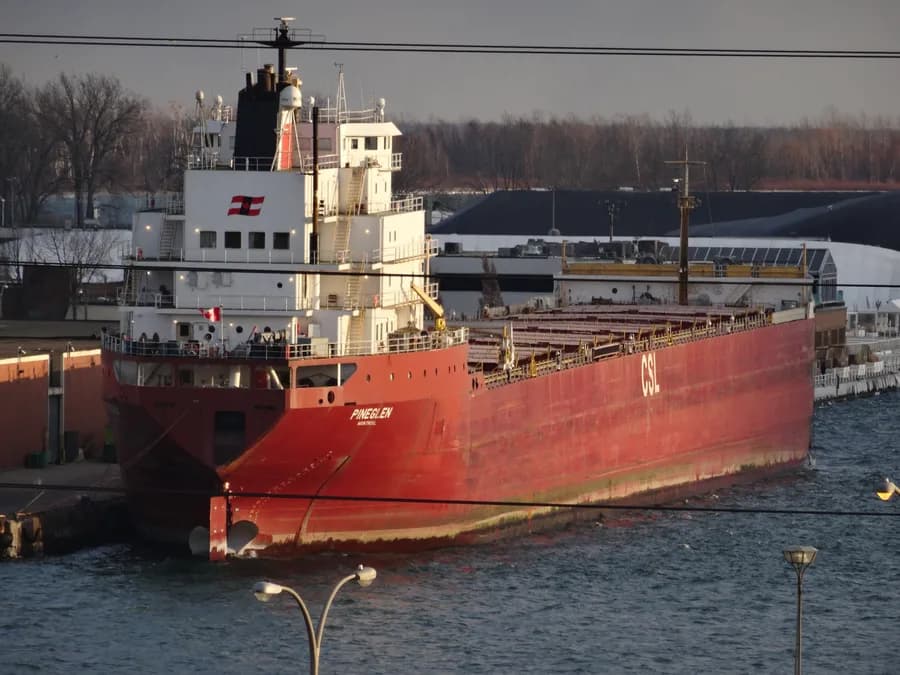
Pineglen was a bulk carrier owned and operated by Canada Steamship Lines. She was built at the Collingwood Shipyards, in Collingwood, Ontario in 1985, to a single superstructure lake freighter design. Initially named Paterson, the vessel was sold to Canada Steamship Lines in 2002 and renamed. Unlike more modern lake freighters she was built to a "straight-deck" design – i.e. she was not equipped with a self-unloading boom. The vessel was sold for scrap in 2017.
Compliance
On 20 December 2016, the bulk carrier "PINEGLEN" struck the wall of the Eisenhower Lock, USA. The vessel proceeded to Montreal, QC for repairs.
On 24 November 2015, the bulk carrier "PINEGLEN" sustained a main engine failure 7 nautical miles SE of Sault Ste. Marie, MI, USA. The vessel proceeded to a nearby anchorage to assess the problem.
On 17 November 2015, the bulk carrier "PINEGLEN" sustained a main engine failure 10 nautical miles SE of Sault Ste. Marie, MI, USA. The crew carried out the repairs and the vessel resumed its voyage.
On 20 July 2011, the bulk carrier "PINEGLEN" experienced a main engine failure 5 miles NE of Les Escoumins,QC. The vessel was towed to Baie Comeau, Qc for repair. Neither injuries nor pollution reported.
On 12 April, 2011, the "PINEGLEN" repaired several hull fractures on the starboard side. The cause is unknown. There was no pollution.
On 31 August 2009, a crack was found on the bottom shell plating in way of the No 2 WBT starboard of the vessel "PINEGLEN".
On 23 March 2008, while coming alongside the dock at Mission River, Thunder Bay, On., a 15 cm crack was discovered in the shell plating below the water line of the bulk carrier "PINEGLEN".
On 22 December 2007, during a vessel escort in ice infested waters in the Port of Quebec, there was a collision between the tug OCEAN RAYMOND LEMAY and the bulk carrier PINEGLEN.
Recorded marine occurrences naming this vessel.
Composite Risk
Multiple adverse factors, or a hard ship-specific signal, lift this hull above the fleet norm.
A coverage-weighted blend of the single component we could read for this hull; the weights renormalise over only the components present, so a thin read is never inflated and a hull is never credited a “safe 0” for a signal it has no row for. This headline is flagged low-confidence (a thin or structural-only read) and should not be treated as a verdict. Higher means riskier. Derived in-house from government-open port-State-control, flag, sanctions and our own vessel data; weight it by the coverage above.
Commercial
Price it in the Route Planner between any two commercial ports: ballast and laden legs, two fuels at live bunker prices, port and canal costs, the weather on the way, and the TCE set against the market.

Visual Archive