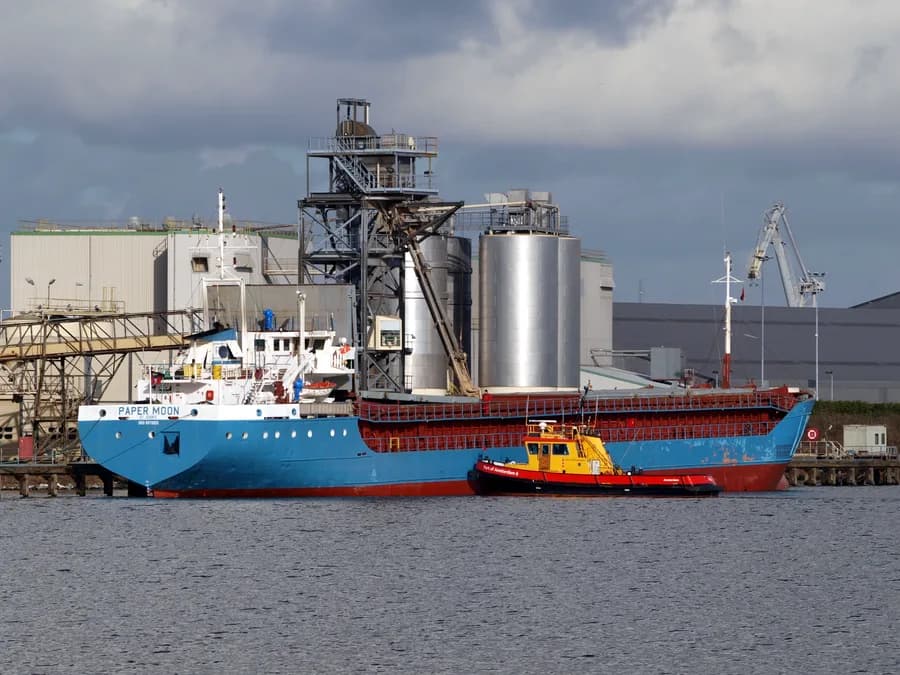
Technical Specifications
Live Tracking
Intelligence
Compliance
Enclosed space entry and rescue drills; Anchoring devices; Rescue boats; Steering gear; Auxiliary engine; Lifebuoys incl. provision and disposition; Maximum hours of work or minimum hours of rest; Wages; Decks - corrosion; ISM
Training and qualification of ship's cook; Rescue boats; Launching arrangements for rescue boats; On board training and instructions; International Anti-fouling-System Certificate; Radio life-saving appliances; Fire pumps and its pipes; Auxiliary engine; Heating, air conditioning and ventilation; Lifebuoys incl. provision and disposition; Heating, air conditioning and ventilation; Railing, gangway, walkway and means for safe passage; Ship specific plans for the recovery of persons from the water; Fire drills; Abandon ship drills; Emergency, lighting,batteries and switches; Cleanliness of engine room; Lifebuoys incl. provision and disposition
Port-State-Control detentions.
Build Series
Sister hulls share a yard, segment, build year (±1) and deadweight (±3%) — the cleanest comparables for valuation. Derived in-house from our fleet register; coverage is limited to hulls carrying a recorded builder, so a series may be incomplete.
Operational Status
Making way at sea speed on its latest broadcast.
Read from the single most-recent AIS broadcast we hold for this hull — we keep no position history, so this is a point-in-time posture, not a dwell inference. Derived in-house from our own AIS feed; weight it by the broadcast age above.
Arrivals, time in port and the load/discharge inferred from the draught change — detected from AIS track history. An open call means the vessel is still in port (no departure observed yet).
Method: each call is a run of fixes inside a port’s geofence confirmed by a stop (or an AIS gap); load/discharge is the sign of the draught delta over the call. Indicative — arrivals before our AIS history began read from the first observation.
Time-in-port summed by port from the AIS-detected port-call history — the ports this vessel has spent the most time at, longest first.
Based on 3 completed calls observed since — open calls (no departure yet) are excluded. The distribution sharpens as AIS history accrues.
Composite Risk
Strong, corroborated adverse evidence — a detention, sanctions exposure or an AIS-gap / behavioural signal.
A coverage-weighted blend of the 3 components we could read for this hull — the weights renormalise over only the components present, so a thin read is never inflated and a hull is never credited a “safe 0” for a signal it has no row for. Higher means riskier. Derived in-house from government-open port-State-control, flag, sanctions and our own vessel data; weight it by the coverage above.
Estimated
Other · summer draught 4.6 m · 9.1 t per cm immersion
Estimate only — modelled from deadweight (hull geometry) using a first-principles hydrostatic model, not measured hydrostatic tables. The design draught it is anchored to is unreliable across the fleet.
Commercial
Explore More