Technical Specifications
Overview
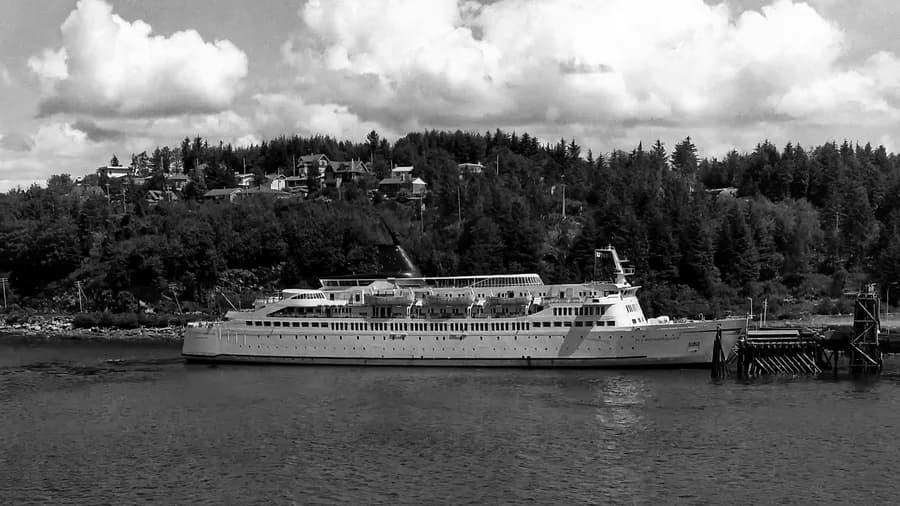
MV Wickersham was a mainline ferry vessel for the Alaska Marine Highway. Wickersham was the second vessel, after the MV Chilkat, in the Alaska Marine Highway fleet to not have been constructed specifically for AMHS, but was rather acquired for from the Stena Line, where it was known as the Stena Britannica and served the Kiel, Germany–Gothenburg, Sweden route. Constructed just one year prior to its purchase by AMHS in April 1968, her arrival and status as an "oceangoing" vessel allowed AMHS to expand the southern terminus of its route system south to Washington and the Port of Seattle. Due to the Passenger Services Act and laws of cabotage, however, the Wickersham could only undergo its Washington-Alaska voyages with an intermediate stop in Prince Rupert, British Columbia. Further complicating her service was her complicated bow unloading system which was only compatible with AMHS ports in Haines, Juneau, Ketchikan, and Sitka, in addition to the ports of Seattle and Prince Rupert. Her large size and draft which served her well in the turbulent waters of Dixon Entrance and other exposed portions of the Alaska-Washington voyage, were too great to slip through passages of water such as Peril Strait en route to Sitka, which forced her to approach Sitka from the outer coast of Baranof Island and through the Pacific Ocean.
Composite Risk
Multiple adverse factors, or a hard ship-specific signal, lift this hull above the fleet norm.
A coverage-weighted blend of the single component we could read for this hull; the weights renormalise over only the components present, so a thin read is never inflated and a hull is never credited a “safe 0” for a signal it has no row for. This headline is flagged low-confidence (a thin or structural-only read) and should not be treated as a verdict. Higher means riskier. Derived in-house from government-open port-State-control, flag, sanctions and our own vessel data; weight it by the coverage above.
Commercial
Price it in the Route Planner between any two commercial ports: ballast and laden legs, two fuels at live bunker prices, port and canal costs, the weather on the way, and the TCE set against the market.
Fleet Management

Visual Archive