Technical Specifications
Overview
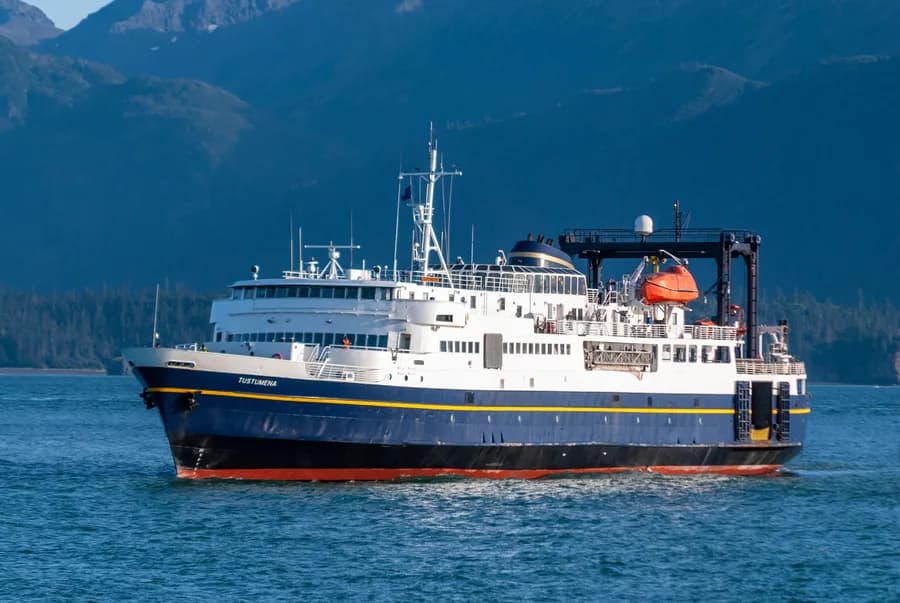
M/V Tustumena is a mainline ferry vessel for the Alaska Marine Highway System. Tustumena was constructed in 1963 by Christy Corporation in Sturgeon Bay, Wisconsin and refurbished in 1969 in San Francisco. As the only mainline ferry in South-central Alaska and the Aleutian Chain, it principally runs between Kodiak, Seldovia, Port Lions, and Homer with Homer providing a road link to the other communities on the Kenai Peninsula. The only interruptions from this schedule occur when making a voyage out the Aleutian Chain (the Aleutian Chain run consists of the communities of Akutan, Chignik, Cold Bay, False Pass, King Cove, Sand Point, and Unalaska/Dutch Harbor) which the vessel undergoes eight times a year all of which occur during the summer as winter weather becomes too dangerous. Because of the exposed and unstable parts of Alaska it plies, the Tustumena is an accredited ocean-going vessel, a quality it shares exclusively with the Kennicott. As such, the Tustumena is replaced by the M/V Kennicott when it undergoes annual maintenance. The Tustumena is the smallest AMHS vessel to have cabins. The Tustumena's amenities include a full service dining room; cocktail lounge and bar (which is now closed; there is wine and beer service at meals); solarium; forward, aft, movie, and business lounges; eight four-berth cabins and 18 two-berth cabins.
Composite Risk
Multiple adverse factors, or a hard ship-specific signal, lift this hull above the fleet norm.
A coverage-weighted blend of the single component we could read for this hull; the weights renormalise over only the components present, so a thin read is never inflated and a hull is never credited a “safe 0” for a signal it has no row for. This headline is flagged low-confidence (a thin or structural-only read) and should not be treated as a verdict. Higher means riskier. Derived in-house from government-open port-State-control, flag, sanctions and our own vessel data; weight it by the coverage above.
Commercial
Price it in the Route Planner between any two commercial ports: ballast and laden legs, two fuels at live bunker prices, port and canal costs, the weather on the way, and the TCE set against the market.

Visual Archive