Technical Specifications
Overview
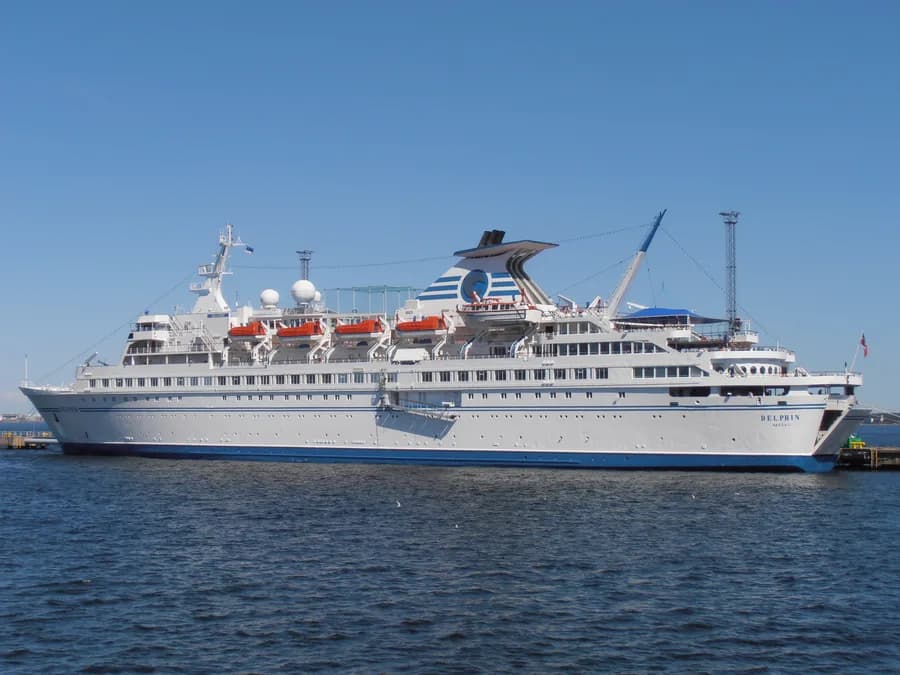
MV Delphin was a cruise ship owned by the Mauritius-based Vishal Cruises Pvt. Ltd., under charter to the Germany-based Passat Kreuzfahrten. Built 1975 by Oy Wärtsilä Ab Turku Shipyard in Finland and renovated 1986 and 1993 by Lloyd Werft, Bremerhaven, Germany and got converted into a cruise ship, with her bow unloading doors permanently welded. In 1992, while being serviced at Singapore's Singmarine Dockyard, she toppled over when a floating dock sank with her in it. In 1993, she went through renovations at Lloyd-Werft again and got completely modernized and elegantly re-equipped. At the same time, the Delphin Seereisen and later Delphin-owned Hansa Kreuzfahrten of Germany, had been chartered until bankruptcy. The ship was managed by MTC Marine Trade Consulting GmbH. Due to the insolvency of Delphin Kreuzfahrten in October 2010, ship was not returned until late 2011 which had been sold to Vishal Cruises Pvt. Ltd. Sister ships are: Azerbaizhan, Gruziya, Kareliya and Kazakhstan. As of February 7, 2018, MV Delphin is chartered by the first cruise line in the Argentine Republic, Alteza Cruises The Delphin operate from the Port of the city of Buenos Aires with various itineraries including Patagonia, southern Brazil, southern Chile and Antarctica.
Composite Risk
Multiple adverse factors, or a hard ship-specific signal, lift this hull above the fleet norm.
A coverage-weighted blend of the single component we could read for this hull; the weights renormalise over only the components present, so a thin read is never inflated and a hull is never credited a “safe 0” for a signal it has no row for. This headline is flagged low-confidence (a thin or structural-only read) and should not be treated as a verdict. Higher means riskier. Derived in-house from government-open port-State-control, flag, sanctions and our own vessel data; weight it by the coverage above.
Commercial
Price it in the Route Planner between any two commercial ports: ballast and laden legs, two fuels at live bunker prices, port and canal costs, the weather on the way, and the TCE set against the market.

Visual Archive