Technical Specifications
Overview
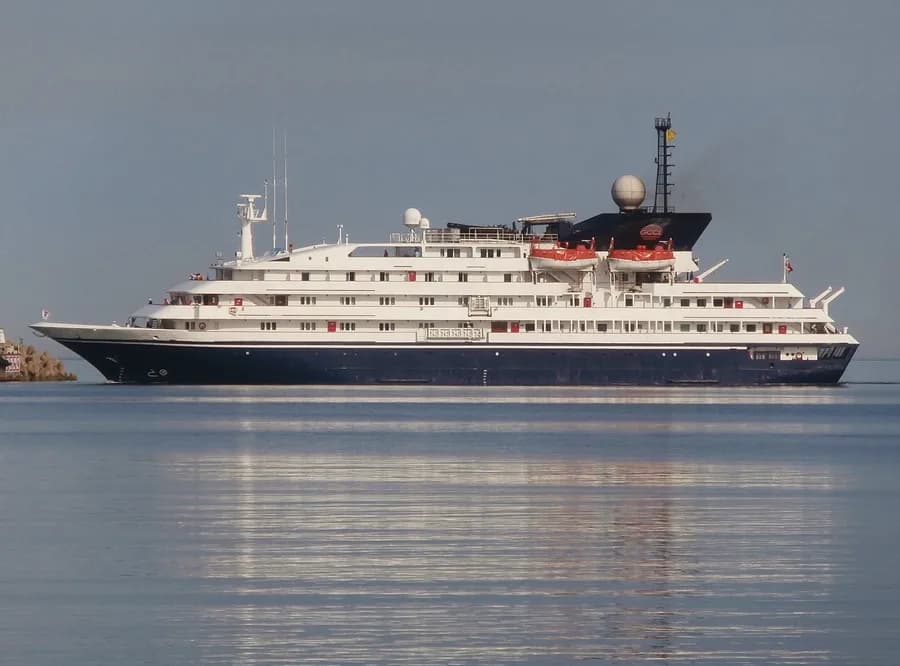
MV Corinthian is a cruise vessel that operates on the Great Lakes, in the Mediterranean, and around Antarctica. Summer ports of call in the Great Lakes include Toronto, Port Weller, Little Current, and Thunder Bay in Ontario, Canada, and Mackinac Island, Houghton, and Duluth in the United States. She was launched in 1990, built by Cantiere Navale Ferrari-Signani in La Spezia, Italy, and was operated by Renaissance Cruises and Great Lakes Cruise Company as the Renaissance IV. After Renaissance Cruises ceased operations, she was known for a time as the Clelia II. In December 2010 the Clelia II was partially disabled by a rogue wave while transiting the Drake Passage. The rogue wave also damaged the ship's bridge. The nearby MS National Geographic Explorer rendered assistance. The London Free Press reported that during its thirteen visits during the 2010 season passengers and crew spent $600,000 CAD in Little Current, a small community on Manitoulin Island. Chartered by New York-based Travel Dynamics International, on 26 December 2009, the Clelia II, ran aground along the Antarctic Peninsula, its starboard propeller hitting the rocks resulting in the shutdown of the starboard engine and loss of electrical power aboard the ship. Another tourist ship, the National Geographic Explorer, was nearby and helped pull it off the rocks. She is currently operated by Grand Circle Cruise Line.
Compliance
On 31 August 2010, while navigating through the North Channel, Lake Huron, Ontario, the passenger vessel "CLELIA II", with a pilot on board, ran aground near Clapperton Island, Ontario. The vessel managed to free itself.
On 06 July 2009, during a portside lifeboat drill aboard the passenger vessel "CLELIA II", the aft release hook was accidentally activated, releasing the boat, thus damaging the suspended lifeboat. Minor oil pollution. TC & Lloyds inspecting.
Recorded marine occurrences naming this vessel.
Composite Risk
Multiple adverse factors, or a hard ship-specific signal, lift this hull above the fleet norm.
A coverage-weighted blend of the single component we could read for this hull; the weights renormalise over only the components present, so a thin read is never inflated and a hull is never credited a “safe 0” for a signal it has no row for. This headline is flagged low-confidence (a thin or structural-only read) and should not be treated as a verdict. Higher means riskier. Derived in-house from government-open port-State-control, flag, sanctions and our own vessel data; weight it by the coverage above.
Commercial
Price it in the Route Planner between any two commercial ports: ballast and laden legs, two fuels at live bunker prices, port and canal costs, the weather on the way, and the TCE set against the market.

Visual Archive