Technical Specifications
Overview
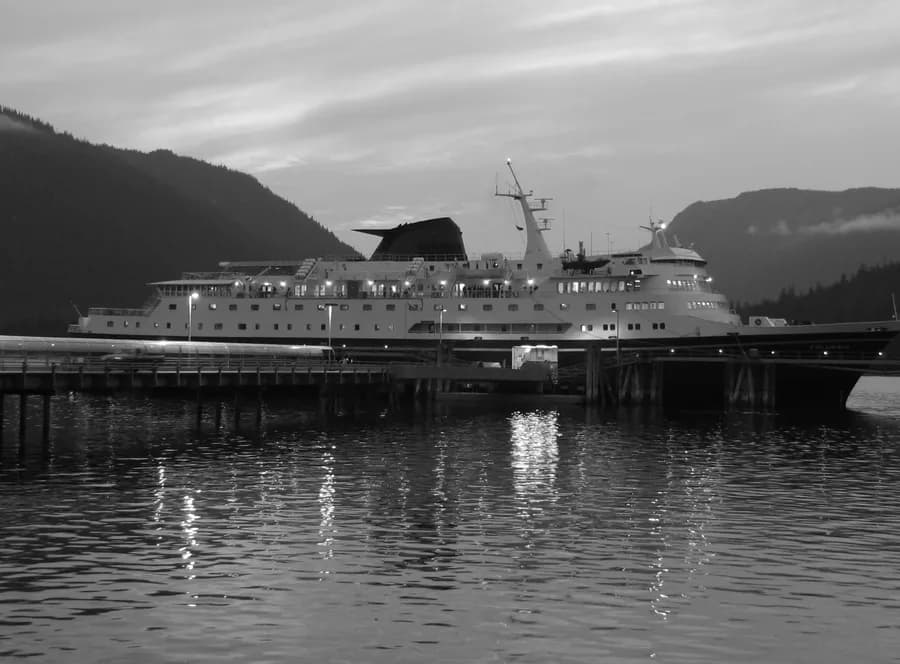
MV Columbia is a mainline ferry for the Alaska Marine Highway System. Constructed in 1974 by Lockheed Shipbuilding in Seattle, Washington, the Columbia has been the flagship of the Alaska ferry system for over 40 years. As a mainline ferry, which means she serves the largest of the inside passage communities (such as Ketchikan, Wrangell, Petersburg, Juneau, Haines, Skagway, and Sitka), her route spans the entirety of the inside passage, often beginning runs in Bellingham, Washington and running to the northernmost Alaskan Panhandle community of Skagway stopping in communities along the way, during the summer season (winter services are sometimes operated by MV Malaspina). Columbia has an upper deck between the main vehicle deck and the cabin deck with additional vehicle stowage accessed by two vehicle elevators capable of hoisting 19 foot vehicles with their passengers, and additional passenger cabins. On July 2, 2006, an auxiliary engine room fire broke out on the Columbia temporarily impairing steering and propulsion on her northbound voyage from Bellingham in Seymour Narrows in Canadian waters. She motored to Duncan Bay, British Columbia for damage assessment before continuing on to Ketchikan's Alaska Ship & Dry Dock for more extensive repairs.
Compliance
On 16 August 2015, the US passenger ferry "COLUMBIA" reported a port main engine failure 0.85 nautical miles SE of Denny Island, BC. The vessel's crew carried out temporary repairs.
Recorded marine occurrences naming this vessel.
Composite Risk
Multiple adverse factors, or a hard ship-specific signal, lift this hull above the fleet norm.
A coverage-weighted blend of the single component we could read for this hull; the weights renormalise over only the components present, so a thin read is never inflated and a hull is never credited a “safe 0” for a signal it has no row for. This headline is flagged low-confidence (a thin or structural-only read) and should not be treated as a verdict. Higher means riskier. Derived in-house from government-open port-State-control, flag, sanctions and our own vessel data; weight it by the coverage above.
Commercial
Price it in the Route Planner between any two commercial ports: ballast and laden legs, two fuels at live bunker prices, port and canal costs, the weather on the way, and the TCE set against the market.

Visual Archive