Technical Specifications
Overview
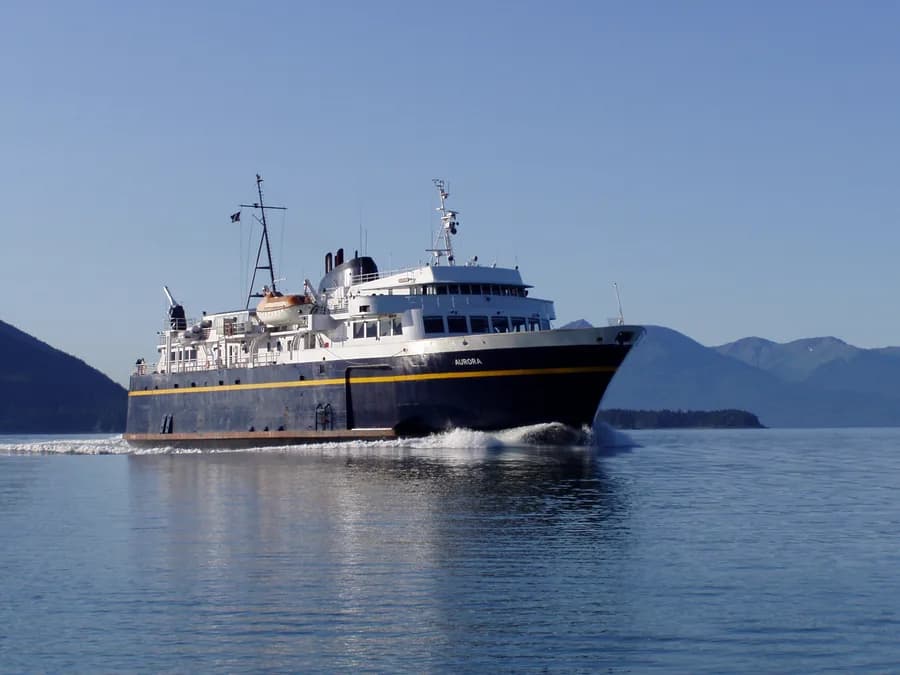
MV Aurora is a feeder vessel for the Alaska Marine Highway System, built in Sturgeon Bay, Wisconsin in 1977 by Peterson Shipbuilders and commissioned by the Alaska Marine Highway System the same year. The Aurora is the younger sister ship to the MV LeConte and both serve or have served as feeder vessels that pick up passengers in small communities such as Pelican and Hoonah and take them to larger regional communities (this process is colloquially known as the "milk run"). However, unlike the LeConte, the Aurora was moved out of Southeast Alaska into Prince William Sound area in 2005 to take the place of the retired MV Bartlett. This move, however, was highly controversial as the MV Chenega, a fast ferry, was supposed to take this role and been promised for years in advance to the Prince William Sound area and specifically to be homeported in the city of Cordova. Instead, the ferry system reneged on this promise and moved the Chenega to a Ketchikan-Wrangell route. Currently, the Aurora is being hubbed out of Cordova (although, unlike the fast ferry, the Aurora operates 24-hours a day so it doesn't have a crew that lives in its homeport thus denying that city the economic stimulus of additional residents/jobs.
Compliance
On 28 September, 2002, the U.S. Reg. Passenger Ferry "AURORA" reported that two crew members fell overboard, near Petrel Rock, B.C. Both persons were recovered.
Recorded marine occurrences naming this vessel.
Composite Risk
Multiple adverse factors, or a hard ship-specific signal, lift this hull above the fleet norm.
A coverage-weighted blend of the single component we could read for this hull; the weights renormalise over only the components present, so a thin read is never inflated and a hull is never credited a “safe 0” for a signal it has no row for. This headline is flagged low-confidence (a thin or structural-only read) and should not be treated as a verdict. Higher means riskier. Derived in-house from government-open port-State-control, flag, sanctions and our own vessel data; weight it by the coverage above.
Commercial
Price it in the Route Planner between any two commercial ports: ballast and laden legs, two fuels at live bunker prices, port and canal costs, the weather on the way, and the TCE set against the market.

Visual Archive