Technical Specifications
Overview
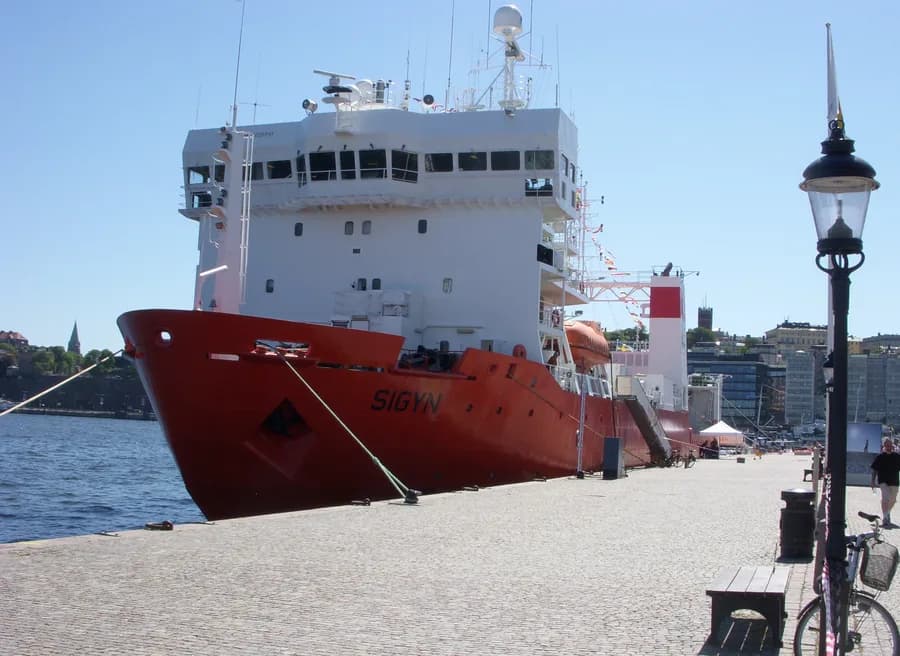
M/S Sigyn was a ship that transported spent nuclear fuel and nuclear waste from Swedish nuclear power plants to Clab, the storage facility at Oskarshamn and the waste facilities at Studsvik and Forsmark. She was named after the goddess Sigyn, the mythological wife of Loki. Her name alluded to the role Sigyn played in holding a cup over the fettered Loki, catching the venom dripping from a viper perched above him. Sigyn was built in 1982 by the French Société Nouvelle des Ateliers et Chantiers du Havre at Le Havre, and could transport up to ten containers for spent fuel or radioactive waste. The ship could also take one or two vehicles or standard shipping containers for low-level waste. A stern ramp enabled roll-on/roll-off loading and unloading from the 59 m (194 ft) long cargo deck. Sigyn was owned by Svensk Kärnbränslehantering AB (SKB) (Swedish Nuclear Fuel and Waste Management Company), but was operated and staffed by Furetank Rederi AB (Furetank Shipping Company) In December 2010 it was announced that SKB have ordered a new ship from the Dutch Damen Group to replace Sigyn. The new ship named Sigrid, was laid down in Galați, Romania, in December 2011, and was delivered in May 2013. In October 2012 this new Nuclear Cargo Vessel 1600 was launched.
Composite Risk
Multiple adverse factors, or a hard ship-specific signal, lift this hull above the fleet norm.
A coverage-weighted blend of the single component we could read for this hull; the weights renormalise over only the components present, so a thin read is never inflated and a hull is never credited a “safe 0” for a signal it has no row for. This headline is flagged low-confidence (a thin or structural-only read) and should not be treated as a verdict. Higher means riskier. Derived in-house from government-open port-State-control, flag, sanctions and our own vessel data; weight it by the coverage above.
Commercial
Price it in the Route Planner between any two commercial ports: ballast and laden legs, two fuels at live bunker prices, port and canal costs, the weather on the way, and the TCE set against the market.

Visual Archive